
Perimenopause vs Menopause: Symptoms, Timeline, and What to Expect

Thinking you may be in perimenopause? Let me guess: your cycle is suddenly unpredictable. Your sleep is a mess. Hot flashes are showing up, then disappearing, then showing up again. But how do we know when we’ve crossed the line from perimenopause into menopause itself? The distinction matters more than most articles let on, because the right support depends on which stage you are actually in. This article gives you clear definitions, a realistic timeline, the 8 most common symptoms by stage, and what to do at each one to not just survive it, but thrive.
Here’s the short version: perimenopause is the 4 to 10 year transition leading up to menopause, typically starting in the early to mid 40s, where hormones fluctuate dramatically and symptoms come in waves. And menopause is actually just a single date: the day that falls 12 months after your final menstrual period. Post-menopause includes everything after that, where your hormones stabilize at their new, lower baseline. Each stage has its own dominant symptom pattern and effective interventions, and learning what they are is the best way to set yourself up for success.
Want to know which stage you’re in and what to actually do about it?
Book a free 15-minute consult with our Winnipeg menopause coaching team. We'll talk through your symptoms, map your stage, and confirm your insurance coverage on the call.

The Stages Defined
Perimenopause
The 4-to 10-year window leading up to menopause. Most women enter perimenopause in their early to mid 40s (though some start in their late 30s, and others not until their early 50s). Hormones (estrogen, progesterone) fluctuate widely during this stage, which is why symptoms can feel unpredictable. You may sleep poorly for two weeks, fine for two weeks, poorly again. Periods get unpredictable: they might be longer, shorter, heavier or lighter, and are sometimes skipped entirely.
Perimenopause ends when you have gone 12 consecutive months without a period; the day after that 12-month mark is menopause.
Menopause
Menopause is technically one day: the day that marks 12 months without a period. The average age in Canada is 51, with a normal range from 45 to 55. Earlier menopause (before 45) is called early menopause; before 40 is called premature menopause. Both warrant a conversation with your physician.
Post-menopause
Everything after that menopause date is technically called post-menopause. Your hormones have stabilized at a new, lower baseline, the wild fluctuation of perimenopause has settled, and many of the most disruptive symptoms (hot flashes, mood swings, sleep disruption) often improve. Some though, tend to persist or worsen if not addressed (think vaginal dryness, bone density loss, weight redistribution).
https://www.gfitwellness.ca/perimenopause-menopause-weight-loss-coaching-winnipeg
https://www.gfitwellness.ca/blog/weight-loss-for-women-over-40
The Typical Timeline
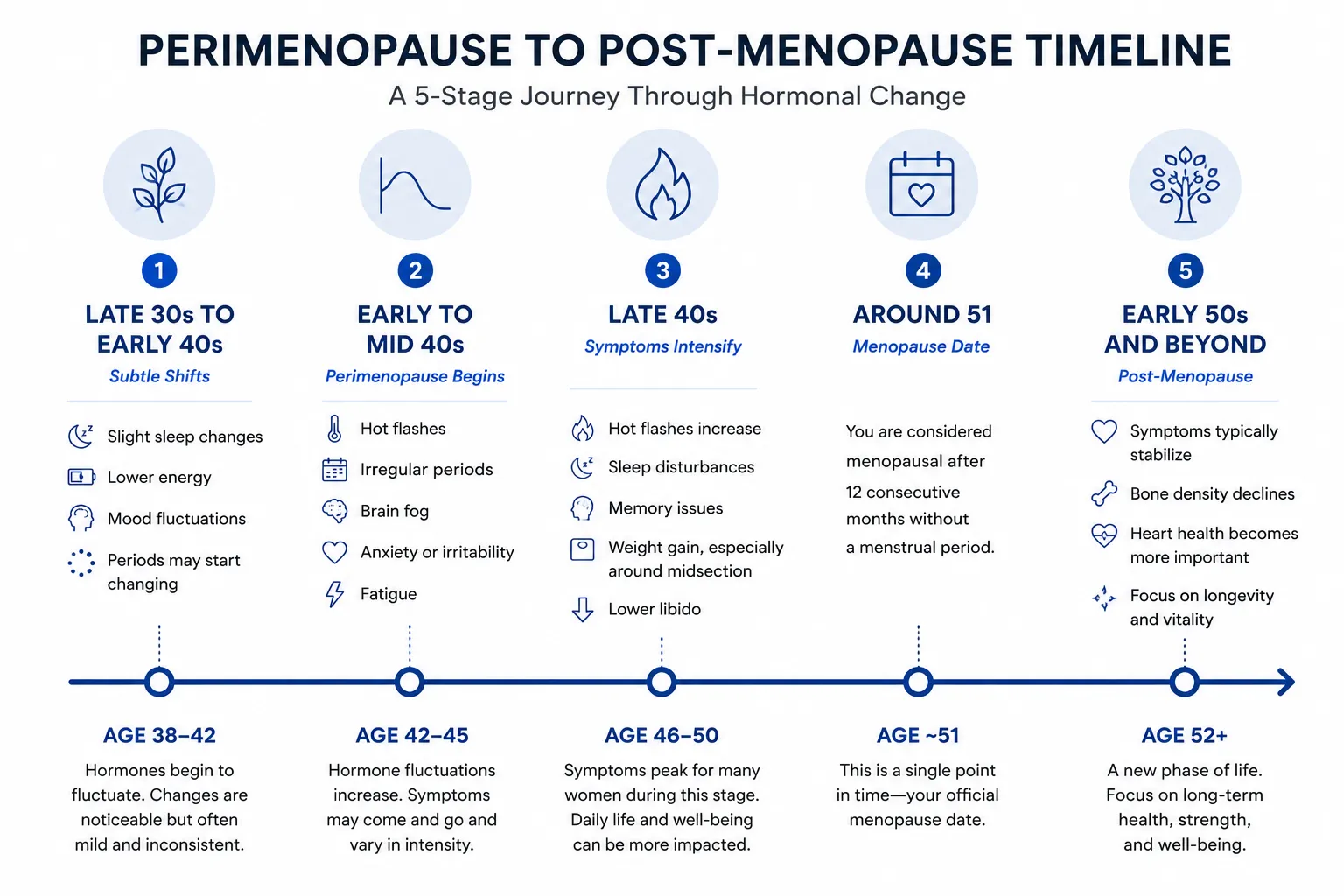
Perimenopause to post-menopause typical timeline: late 30s to early 40s subtle hormone shifts, early to mid 40s perimenopause begins, late 40s symptoms intensify with hot flashes, around age 51 average menopause date, early 50s and beyond post-menopause.
Broadly speaking, most women follow a similar timeline, but individual variation is huge. Three women in their early 50s can be in three different stages.
- Late 30s to early 40s: hormones begin subtle shifts. Most women feel normal but may notice cycle length changes, slightly worse PMS, or early sleep changes.
- Early to mid 40s: perimenopause begins for most women. Cycle becomes more irregular. Sleep, mood, and energy start to fluctuate.
- Late 40s: perimenopause symptoms typically intensify. Hot flashes often begin. Periods may be heavier or skipped.
- Around 51 (average): menopause occurs. The single date marker after 12 months without a period.
- Early 50s and beyond: post-menopause. The worst of the fluctuation usually settles. New patterns (bone density, fat distribution, vaginal health) become the longer-term concerns.
Surgical menopause (after a hysterectomy that includes ovary removal) follows a different timeline: hormones drop suddenly rather than gradually, and the symptoms can be more abrupt and intense. This usually warrants an earlier conversation about HRT.
The 8 Most Common Symptoms by Stage
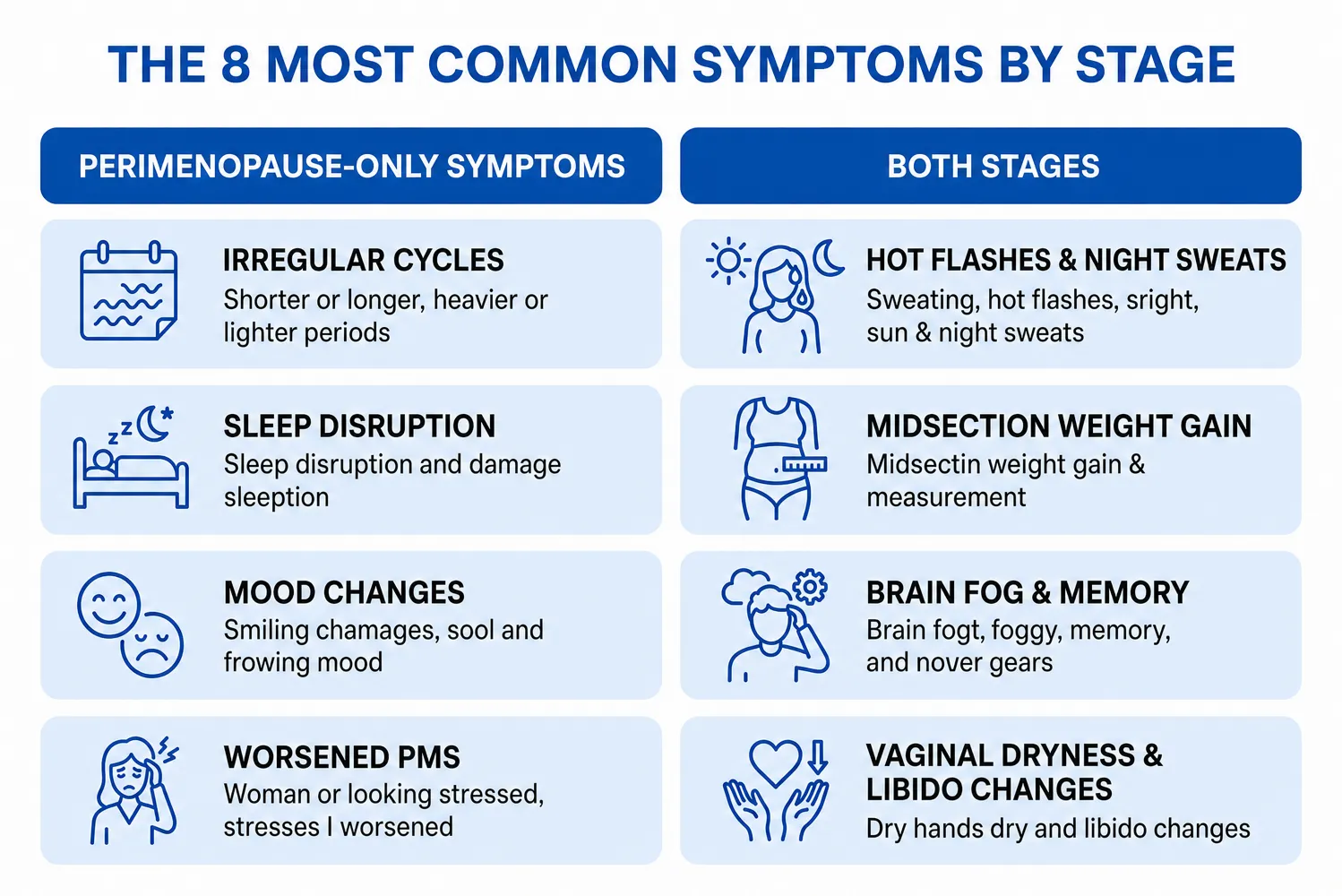
Some symptoms appear in both perimenopause and post-menopause. Others are more characteristic of one stage.
Symptoms most common in perimenopause
- Irregular cycles (longer, shorter, skipped, heavier, lighter).
- Sleep disruption (especially 3 am wakeups).
- Mood changes, irritability, anxiety.
- Worsened PMS.
Symptoms that often appear during perimenopause and continue into menopause
- Hot flashes and night sweats (vasomotor symptoms).
- Weight gain, especially around the midsection.
- Brain fog and memory lapses.
- Vaginal dryness and changes in libido.
"The most common things I hear in intake calls are: “I think something is wrong with me!” But honestly, it’s just biology. Once we identify the stage you’re in, we can manage your symptoms and make a game plan that works with your body, not against it." Suzanne Harden, GFIT menopause coaching lead.
When to Act
In perimenopause
Build the strength training, protein, sleep, and stress habits now. The perimenopause window is the most predictive of post-menopause health, and the habits you build here carry forward. Have a baseline conversation with your physician about bloodwork (thyroid, vitamin D, ferritin, B12, A1C, lipids) and HRT options if your symptoms are interfering with your quality of life.
At menopause
Confirm with your physician using the 12-month period absence criterion. Review your bone density, cardiovascular markers, and have a conversation about HRT (if not already started). Adjust nutrition and training to reflect your now-stable hormonal baseline.
Post-menopause
Strength training and protein become even more important as the cyclic estrogen exposure ends and muscle loss accelerates. Bone density screening is standard. Cardiovascular risk increases after menopause, so blood pressure, lipids, and weight management become higher priority.
When to Bring in a Coach (And When to Bring in a Doctor)
A coach can help with the nutrition, training, sleep, stress, and habit changes. But a physician handles the medical questions: HRT, bone density, cardiovascular risk, and the underlying medical workup. Most women benefit from both.
Bring in a coach when:
- Weight, energy, or body composition has shifted and you want a stage-appropriate plan.
- You’ve tried the standard advice and it’s not working (common in perimenopause specifically).
- You want accountability through the 1 to 2 year window where habit changes have to stick.
Bring in a physician when:
- Symptoms are interfering with quality of life and HRT is on the table.
- Periods become very heavy, very irregular, or stop suddenly before age 45.
- You have a family history of early osteoporosis, cardiovascular disease, or early menopause.
One of our Winnipeg clients, Linda, came to us at 48 convinced she was in menopause. Her cycles had been irregular for 18 months and her sleep was wrecked. We mapped her symptoms and figured out she was mid-perimenopause. Her physician adjusted her bloodwork timing accordingly, and discussed HRT. Working alongside her physician, we built a stage-appropriate plan. Six months later her sleep was back, her weight had dropped 9 pounds, and she was back on track.
Want to know which stage you’re in?
Book a free 15-minute consult with our Winnipeg menopause coaching team. We'll talk through your specific symptom pattern and confirm your insurance coverage on the call.
Frequently Asked Questions
On average, 4 to 8 years, with a normal range of 2 to 10. Some women have a brief perimenopause window of 2 years; others have a decade of symptoms before reaching menopause. Know that the duration is not predictive of how easy or difficult the transition will be.
51 years. Normal range is 45 to 55. Before 45 is called early menopause; before 40 is called premature menopause. Both warrant medical evaluation.
Yes. Fertility declines during perimenopause but does not stop until you have gone 12 consecutive months without a period. If pregnancy is not desired, continue contraception until menopause is confirmed.
Stress and perimenopause share many symptoms (sleep disruption, mood changes, irritability). The distinguishing features of perimenopause are cycle irregularity, vasomotor symptoms (hot flashes and night sweats), and the gradual onset over months to years rather than the more situation-specific pattern of stress. Bloodwork (FSH, estradiol) can support the diagnosis but is not always definitive during the wide fluctuation of early perimenopause.





Book a call with our Wellness Coordinator to learn more


