
Weight Loss for Women Over 40: What Actually Works
You used to be able to skip a few meals, walk a little more, and boom, drop five pounds easily before a trip. Now? You use the exact same tricks, and the scale doesn't move an inch. The good news, though? Your body isn’t actually broken; the rules just changed when you hit your 40s, and nobody told you.
Here’s the short version: after age 40, weight loss requires a new playbook. That’s where the GFIT 5 Levers for Women Over 40 come in: more protein than you think, strength training twice a week minimum, sleep and stress treated as non-negotiables, less alcohol than feels socially comfortable, and 8,000 to 12,000 steps a day. The old playbook of move more and eat less actively backfires after 40. Most women we work with in Winnipeg have been doing the wrong version of the right thing for years - but there is a fix. Let’s fix it!
Tired of doing everything right and seeing nothing change?
Book a free 15-minute consult with our Winnipeg-based perimenopause and menopause coaching team. We'll review what you've been doing, identify what's actually slowing progress at your specific stage, and confirm your insurance coverage on the call.
"The women who get traction in their 40s do not work harder than the women who do not - they just work differently. The ‘eat more, move less’ that worked well at 32 does more harm than good at 47. The good news? Once we change the inputs, the body responds remarkably quickly - usually within six weeks." Suzanne Harden, GFIT perimenopause and menopause coaching lead.

Why Weight Loss Changes After 40
There are three predictable biological shifts at play that make the old playbook stop working.
1. Muscle loss accelerates
Starting in your mid-30s and accelerating in your 40s, you lose roughly 1% of muscle mass per year - unless you actively strength train. Less muscle = a lower resting metabolic rate. The "same diet, more weight" experience most women describe in their 40s is largely due to this effect. By 50, a woman who has never lifted weights may have lost 15 to 20% of her peak muscle mass, which translates to roughly 100 to 150 fewer calories burned per day at rest.
2. Estrogen begins its decline
Perimenopause typically starts in your early to mid 40s and progresses into your early 50s. Estrogen plays a major role in insulin sensitivity, fat distribution, sleep quality, and recovery from exercise. As estrogen drops, the same food intake creates more fat storage (especially around the midsection), and the same workout creates more fatigue. This is not a willpower problem, and it’s also not a sign you need to eat less. It is a sign you need a different approach.
3. Cortisol stays elevated longer
Stress is not suddenly more present in your 40s - your body just can’t handle it as well. Higher baseline cortisol drives both fat retention and disrupted sleep, which compounds everything else. The 3 am wakeups most perimenopausal women describe are almost always a cortisol pattern. And when cortisol stays elevated, weight stays stuck.
The GFIT 5 Levers for Women Over 40
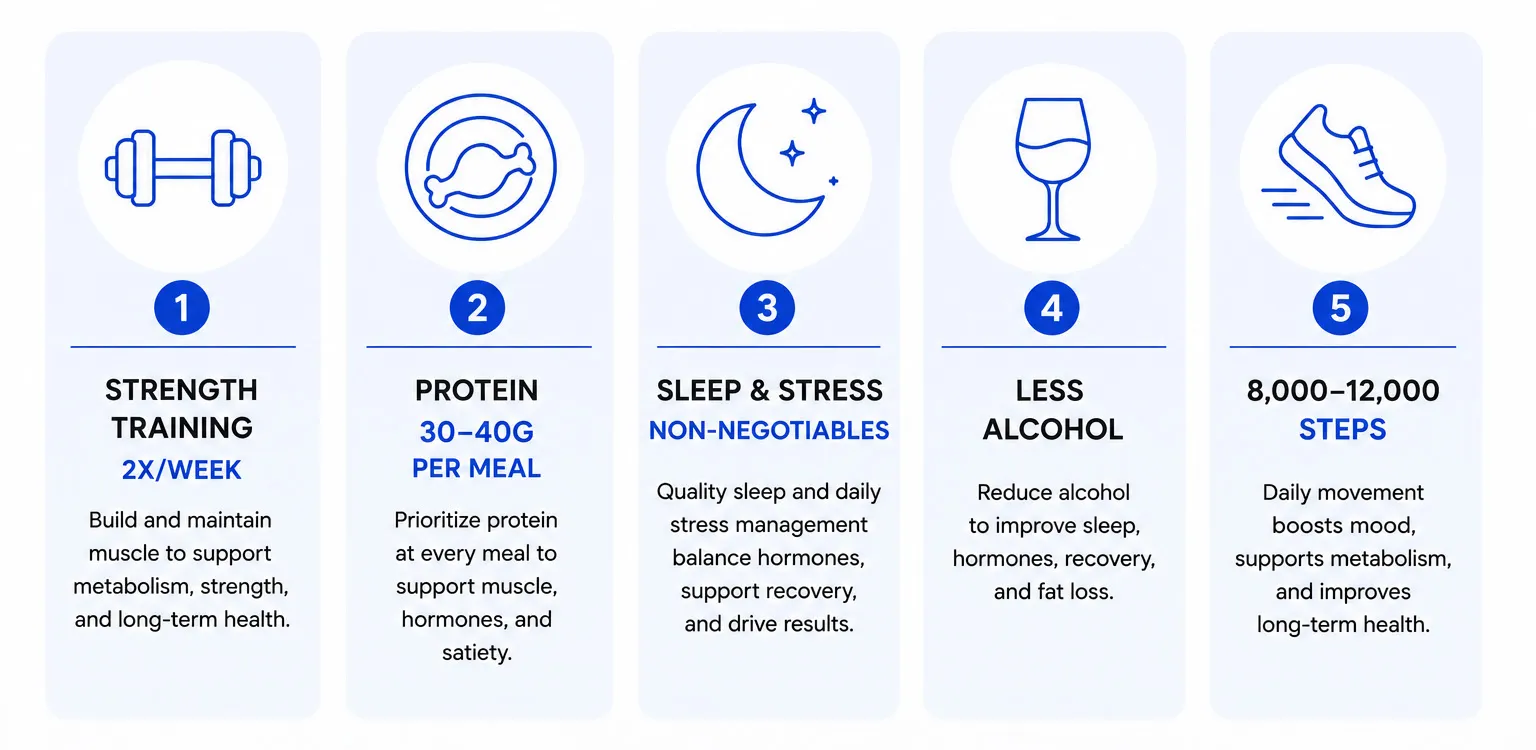
1. Strength training, twice a week minimum
If you do nothing else on this list, do this!
The blueprint: Two full-body sessions per week, clocking in around 30 to 40 minutes each. You need compound movements: squats, hinges, pushes, pulls. You need to progressively overload, meaning you add weight or reps over time. You do not need a personal trainer to start. Home workouts work too, as long as you can invest in some weights. Group classes won’t cut it, they don’t provide an effective stimulus for the adaptation we’re trying to create, even if they ‘feel’ harder.
Most women in their 40s have never lifted weights properly, so the first 8 to 12 weeks feel awkward. Push through. By month three, you will notice things you do not notice on the scale: better sleep, more energy, easier to carry groceries, fewer aches and pains, and clothes fitting differently even at the same weight.
2. Protein, at least 30 to 40 grams per meal
Most women over 40 eat around 50 to 70 grams of protein per day - but the amount that actually preserves muscle and reduces appetite is closer to 100 to 130 grams (for a 70-kilogram, 155-pound woman).
This looks like: at least 30 grams at breakfast (two eggs plus a single-serve Greek yogurt plus a scoop of protein powder). 35 grams at lunch (chicken or fish or tofu, plus a side). 30 grams at dinner (similar). One protein snack in the afternoon (Greek yogurt, cottage cheese, or a clean protein bar) for the remainder. Three meals plus one snack, each anchored by a protein, and you can hit your target.
3. Sleep and stress, treated as non-negotiables
"I'll sleep when I'm dead" stops being funny in your 40s. Sleep deprivation directly increases hunger hormones (ghrelin), decreases satiety hormones (leptin), and raises cortisol. You can run a perfect diet and a perfect training program, and chronic poor sleep will quietly undo most of it.
Specifics that work:
- 7 to 9 hours per night.
- Consistent bedtime and wake time (yes, weekends too).
- No alcohol within 3 hours of bed (more on alcohol below).
- A 10-minute wind-down before bed; no screens for the last 15 minutes.
- Cool, dark bedroom. Most perimenopausal women sleep better below 19°C / 66°F.
Stress is harder to fix because most of it is structural. But what you can do: schedule recovery time the way you schedule meetings, take a walk between stressful blocks, notice when you are using food to manage stress. Emotional eating after 40 compounds faster because the system has less reserve to absorb it.
4. Less alcohol than feels socially comfortable
Alcohol does four things that work against us: it adds calories that do not contribute to satiety, it disrupts sleep architecture even at moderate doses, it raises cortisol overnight, and it impairs muscle protein synthesis. A 5-ounce glass of wine has about 130 calories. Two of those most evenings is roughly 1,800 calories per week, or 26 pounds per year, and this is before you even account for the sleep and recovery costs.
You do not have to stop drinking entirely. But if you are stuck, and you are drinking more than three to four drinks per week, cutting back is almost always the highest-leverage single change you can make this month.
5. 8,000 to 12,000 steps per day
Walking is the underrated metabolic intervention. It burns calories without driving the rebound hunger that intense cardio creates, supports insulin sensitivity, improves recovery, and stabilizes both mood and sleep.
You don’t need a gym for this. A morning walk to start the day, plus a 20-minute walk after dinner, gets most women to their target. The Winnipeg winter is the most-cited obstacle we hear to hitting your steps. The fix is to plan around it (a treadmill at home, mall walking, a step-friendly office building, a 6 am gym membership). And do this before December hits, not in the middle of January.
The 4 Things That Stop Working After 40 (the Drop List)
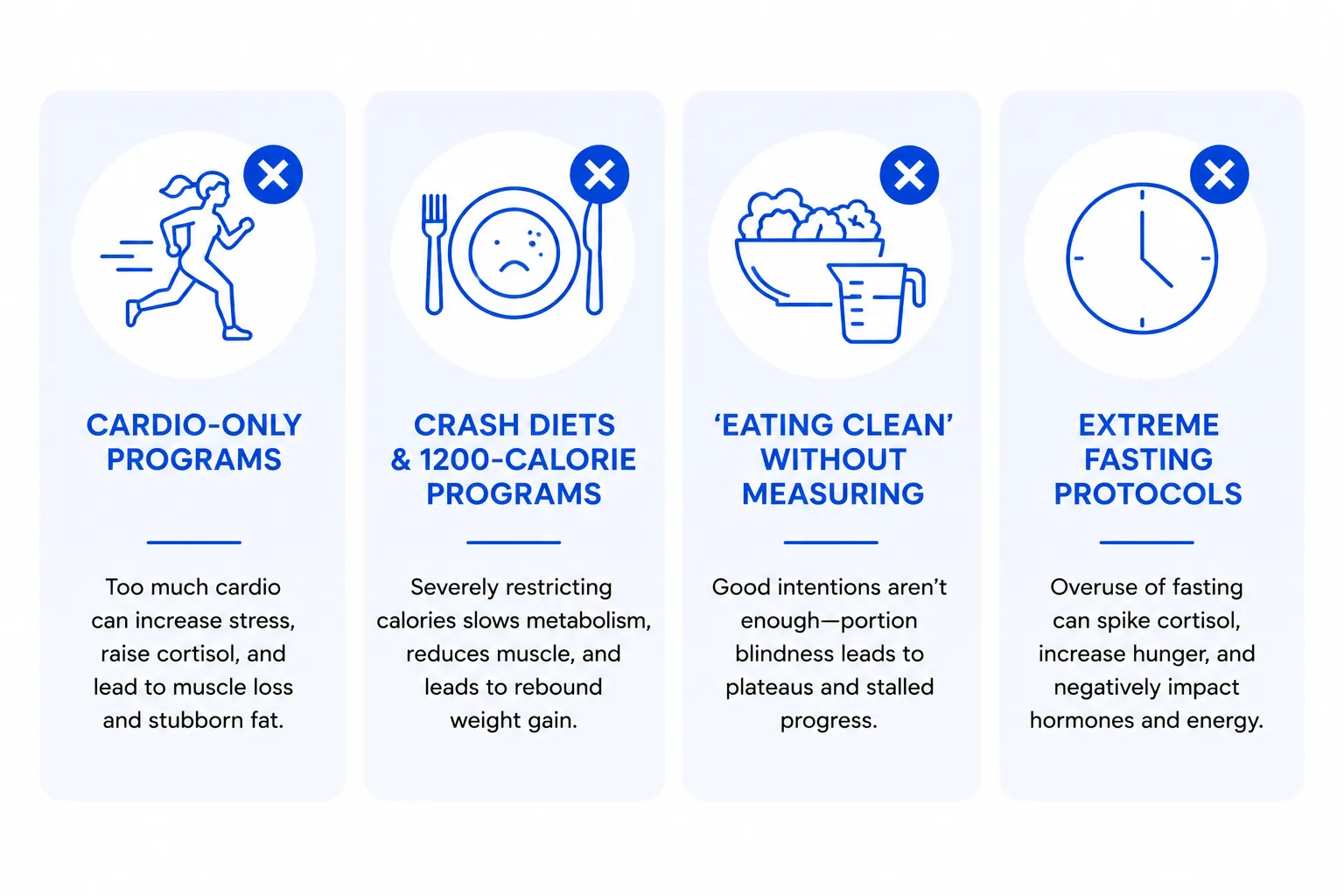
Just as important as what to add is what to stop doing. Here’s what you can let go of:
Cardio-only programs
Long steady-state cardio without strength training accelerates muscle loss after 40, which is the exact opposite of what you need. Cardio is a supplement to strength training, not a substitute. If you have been running, spinning, or doing bootcamp classes 4 to 6 days a week and getting nowhere, this is almost always the diagnosis.
Crash diets and 1,200-calorie programs
Aggressive calorie deficits crash hormones (thyroid, sex hormones, cortisol), accelerate muscle loss, and create rebound eating that erases weeks of progress in days. Smaller deficits, held longer, with high protein, win every time after 40. If your plan has you consistently eating under 1,500 calories a day and you are over 40, it’s the wrong plan!
"Eating clean" without measuring
Most women over 40 who think they are eating in a deficit are actually eating at maintenance. A two-week honest food log usually reveals 300 to 500 hidden daily calories from nut butters, oils, dressings, "healthy" snacks, weekend drift, and bites and tastes while cooking. The food itself is not the problem; the unmeasured volume is. Food can be healthy and nutrient-dense, and still easily take you out of a deficit.
Extreme fasting protocols
OMAD, prolonged fasts, and very long fasting windows work for some women in their 20s and 30s, but in perimenopause, they often worsen cortisol, disrupt sleep, and trigger binge cycles. A modest 12 to 14-hour overnight fast is plenty. Longer is not better at this life stage.
One of our Winnipeg clients, Susan, came to us at 49 after two years of doing what she had always done: a high-intensity bootcamp class four mornings a week, eating around 1,300 calories, no alcohol on weekdays, and still seeing no progress. We changed three things over six weeks: dropped the cardio classes and added two strength sessions, raised her calories to 1,750, with most of the increase going to protein, and added a 25-minute post-dinner walk. She lost 11 pounds and three inches off her waist in the next three months.
When to Bring in a Coach
DIY works if you have the time, the consistency, and the willingness to wait through the 8 to 12 weeks of feeling like nothing is changing. Here are three signs you should bring in a coach:
- You have tried the changes above, and gotten lost in the details (or worse - started gaslighting yourself into thinking you’re not making progress). Coaches save months of trial and error.
- You’re navigating perimenopause symptoms (sleep disruption, mood swings, hot flashes) on top of weight gain. The two are connected and need a coordinated plan.
- You want accountability through the first 90 days, which is the highest attrition window for any program.
At GFIT, our menopause weight loss coaching is built specifically for women in this life stage. Most of our Winnipeg clients are insurance-covered through Manitoba Blue Cross, Canada Life, Sun Life, Manulife, or Green Shield, which means a typical 12-week program runs little to nothing out of pocket if you have benefits.
Ready to actually move the needle?
Book a free 15-minute consult with our Winnipeg perimenopause and menopause coaching team. We'll map your next 90 days, identify which of the five levers will move fastest for you, and confirm your insurance coverage on the call. No pressure, no upsell.
Frequently Asked Questions
Three biological shifts: muscle mass declines roughly 1% per year unless you strength train, estrogen drops during perimenopause and changes insulin sensitivity and fat distribution, and baseline cortisol stays elevated longer. The same calorie intake and the same workout produce different results in your 40s than they did in your 30s. The fix is changing the inputs, not adding more willpower.
Both, but if you can only do one, strength training. Two full-body strength sessions per week is the highest-leverage habit for weight loss and body composition after 40. Cardio can support it when used properly, especially daily walking - but cardio on its own without strength training accelerates muscle loss and makes fat loss harder, not easier.
Between 1.4 and 2.0 grams of protein per kilogram of body weight per day. For a 70-kilogram (155-pound) woman, that is 100 to 140 grams daily, distributed across three meals and one snack at 30 to 40 grams each. Most women over 40 are eating about half of this and do not realize it until they track for two weeks.
A modest 12 to 14-hour overnight fast is fine and can support sleep and digestion. Longer fasting windows (16:8, 18:6, OMAD, prolonged fasts) often worsen cortisol, disrupt sleep, and trigger binge cycles in perimenopausal women. If you have tried longer fasting and feel worse rather than better, that is valuable information. Switch to a shorter window.
HRT is not a weight loss intervention, but for some women, it makes weight loss meaningfully easier by stabilizing sleep, mood, and energy. The decision to start HRT is a conversation with your physician based on your full symptom picture, not just weight. If you are considering it, your coach can help you assemble the picture you bring to the appointment.




Book a call with our Wellness Coordinator to learn more


