
Loose Skin After GLP-1 Weight Loss: What Actually Helps

Losing 40 or 50 pounds on Ozempic is a fast process, and unfortunately, it’s faster than the skin underneath the fat can adapt to. Most patients see some degree of loose skin, especially around the abdomen, upper arms, and inner thighs. Some of it improves over the following 6 to 18 months as the dermis remodels, but some of it does not. This article walks through what actually causes loose skin on GLP-1s, what helps, what does not, and when to consider surgical options.
Here’s the short version: loose skin is driven by the speed of weight loss, the amount lost, your age, your baseline skin elasticity, and your protein and strength training during the loss. Slowing the rate of loss, prioritizing protein and resistance training, staying hydrated, and giving your skin 12 to 24 months to remodel handles most cases. For severe cases after maximum loss is reached, plastic surgery (body contouring) is the only definitive answer.
Losing weight fast on GLP-1 and worried about loose skin?
Book a free 15-minute consult with our Winnipeg GLP-1 coaching team. We'll review your situation, build a plan, and confirm your insurance coverage on the call.

Why Loose Skin Happens on GLP-1s
Skin is a living tissue that adapts to changes in body size, but slowly. When weight is lost over 12 to 24 months, the dermis (the elastic layer beneath the surface) typically remodels to match the new body. But when weight is lost over 4 to 8 months (a common GLP-1 timeline), the dermis lags, and the collagen and elastin network that gave the skin its previous shape can’t rebuild fast enough to match the new contours.
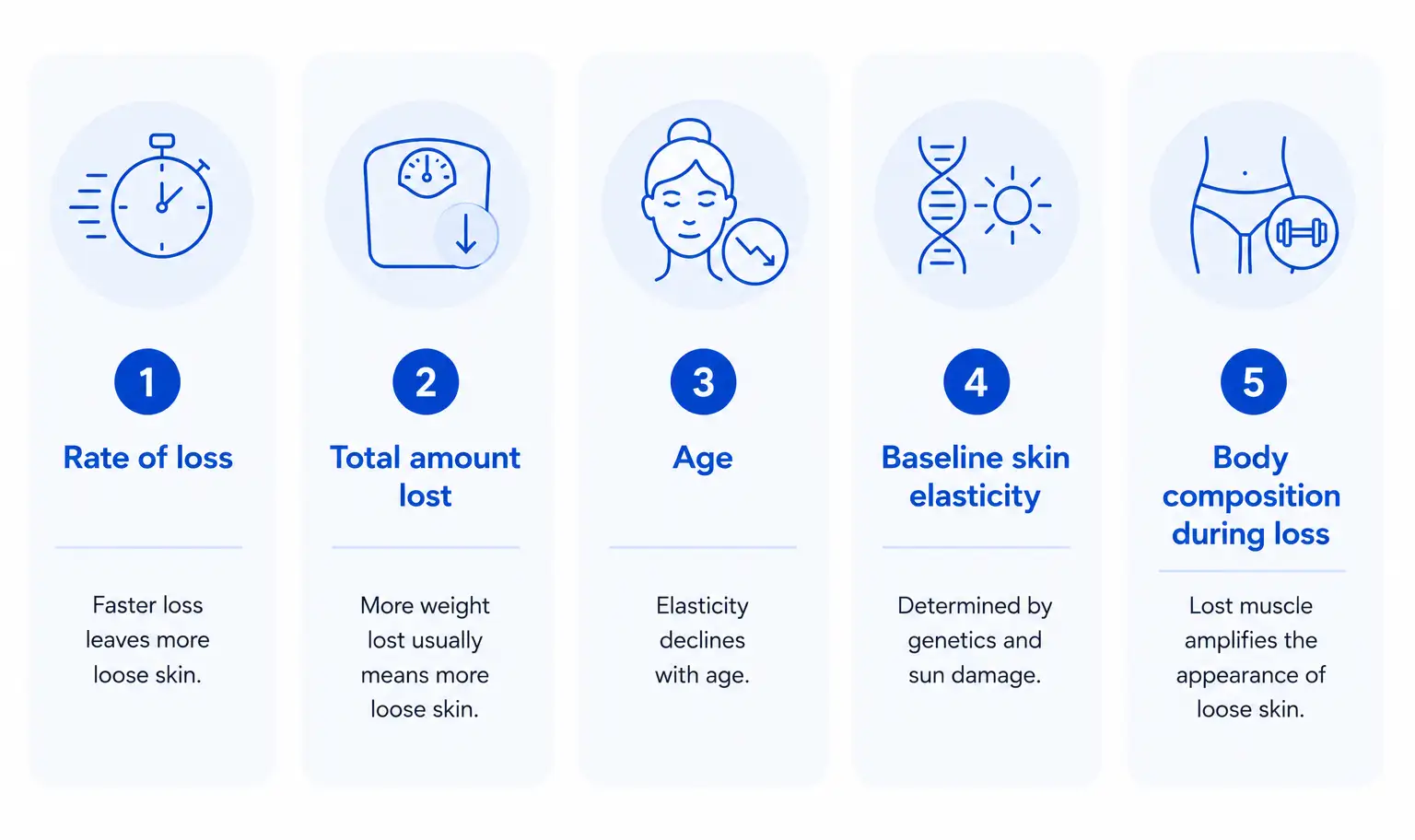
Five factors determine how much loose skin you end up with:
- Rate of loss. Faster loss leaves more loose skin.
- Total amount lost; more weight lost means more skin surface area to adapt.
- Age. Skin elasticity declines with age; the same loss at 30 produces less loose skin than at 55.
- Baseline skin elasticity. Genetics, sun damage history, and hydration affect starting elasticity.
- Body composition during loss: lost muscle alongside fat amplifies the loose skin appearance; preserved muscle reduces it.
What Actually Helps
1. Slowing the rate of loss
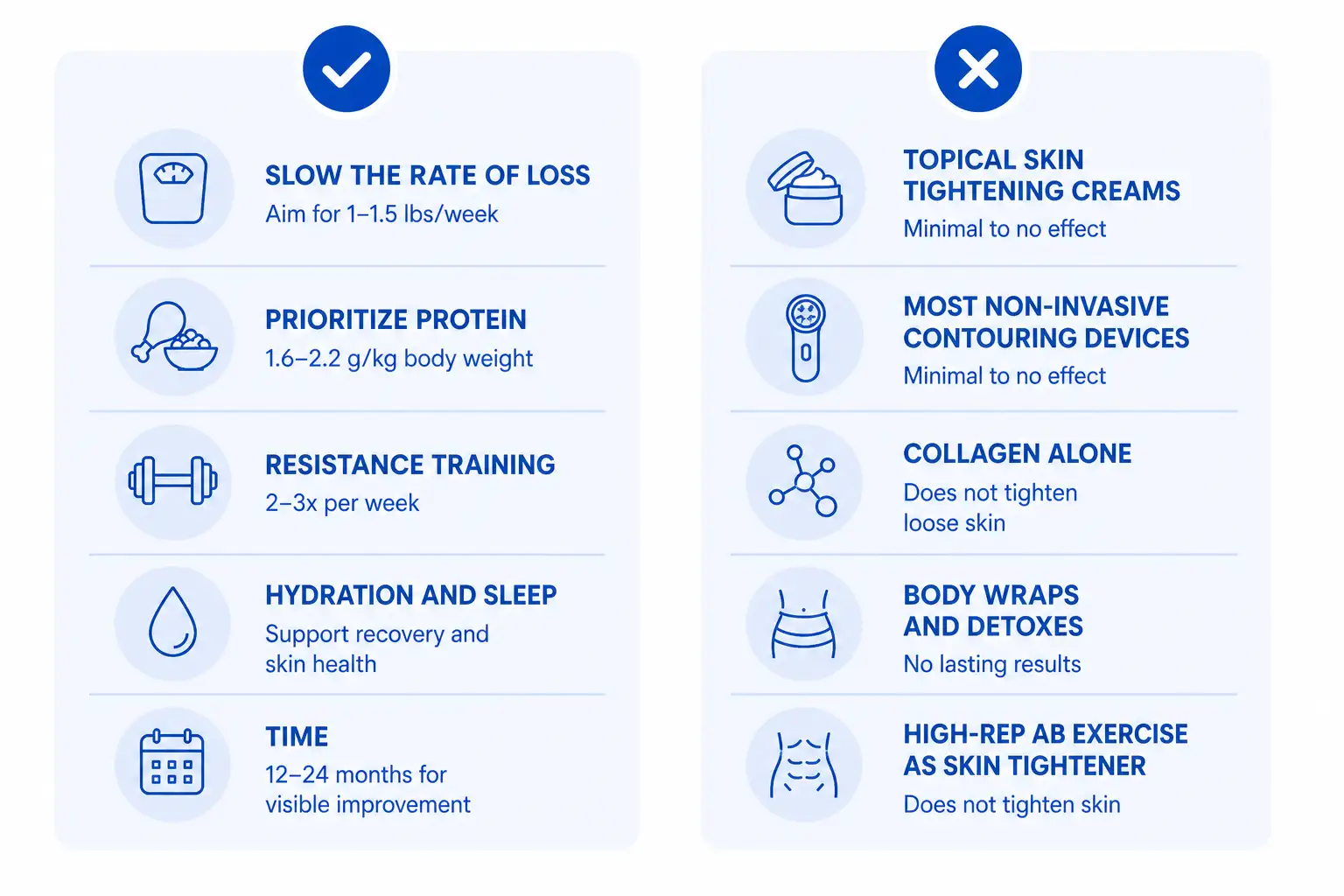
If aesthetic outcomes matter to you, a slower GLP-1 weight loss curve (1 to 1.5 lbs per week rather than 2 to 3) gives skin more time to adapt. This is a conversation with your prescriber about your dose progression and goals.
2. Prioritize protein
Adequate protein (1.6 to 2.2 g/kg per day) supports the connective tissue rebuild and limits muscle loss that would otherwise amplify the loose skin appearance. Most GLP-1 patients eat too little protein and see worse loose skin outcomes as a result.
www.gfitwellness.ca/blog/how-to-eat-on-a-glp-1-without-losing-muscle
3. Resistance training
Building muscle under the skin during weight loss reduces loose skin appearance more than almost any other intervention. Two to three full-body strength sessions per week, with progressive overload, is the floor.
4. Hydration and sleep
Both support skin remodelling and dermal recovery. 2 to 3 litres of water daily and 7 to 9 hours of sleep are the basics. Neither produces dramatic effects alone, but both compound and help results over months.
5. Time
Skin continues to remodel for 12 to 24 months after the weight loss stops. The loose skin you see at month 6 is usually meaningfully better at month 18 even with no additional intervention. Patience matters.
"Trust me, the clients who see the best skin outcomes aren’t the ones who use special creams. They’re the ones who hit their protein, lift weights, and let time do its work. Skin remodels for 18 months after the loss stops, and most people give up assessing at month 6." Sarah Knight, Major Weight Loss and GLP-1 Support Coach
What Does Not Help (Despite the Marketing)
- Most topical skin tightening creams. Limited evidence; expensive; do not penetrate to the dermal layer that matters.
- Non-invasive body contouring devices (most). Some effect on small areas in some studies; expensive; rarely worth it for significant loose skin.
- Collagen supplements as a primary intervention. May modestly help if combined with everything above; do not work in isolation.
- Body wraps and detoxes. No evidence.
- Very high-rep abdominal exercise as a skin tightener. Builds muscle (good) but does not tighten skin directly.
When to Consider Surgery
For severe loose skin after maximum weight loss is reached (typically 18+ months of stable weight), surgical body contouring is the definitive answer. Common procedures:
- Abdominoplasty (tummy tuck) for abdominal loose skin.
- Brachioplasty (arm lift) for upper arm loose skin.
- Thigh lift for inner thigh loose skin.
- Body lift for circumferential loose skin (common after large GLP-1 losses).
These are real surgeries with real recovery times and meaningful costs ($8,000 to $30,000+ in Manitoba depending on procedure). Some are covered by Manitoba Health in cases of significant functional impairment (hygiene, infections, mobility), but most are private-pay.
Timing matters: surgery is most successful when weight has been stable for 12+ months. Operating on someone still losing weight produces worse outcomes.
One of our Winnipeg clients, Mark, lost 78 pounds on Wegovy over 11 months. He had significant abdominal loose skin at month 12. He committed to strength training, hit his protein consistently, and gave it time. At month 24 he had visible improvement but ultimately chose abdominoplasty. The surgery went well. And the combination of body composition work before and after surgery produced an outcome neither alone would have.
Want a plan to minimize loose skin during your GLP-1 journey?
Book a free 15-minute consult with our Winnipeg GLP-1 team. We'll walk through your specific case and confirm your insurance coverage on the call.
Frequently Asked Questions
Loose skin becomes likely above 30 to 40 pounds of loss, more likely above 50, and almost guaranteed above 80 pounds. The amount of loose skin scales with total loss, age, and rate of loss.
Some yes, some no. Mild loose skin often improves substantially over 12 to 24 months with the right inputs (protein, strength training, hydration, time). Severe loose skin after large weight loss usually does not fully resolve without surgery. The honest answer at month 6 is: wait until month 18 before deciding.
Modestly, when combined with everything else (protein, training, hydration, time). 10 to 20 grams of collagen daily for 6+ months has some evidence for skin elasticity. It does not work as a substitute for the other interventions.
Most plastic surgeons recommend waiting until weight has been stable for 12 months. Operating while weight is still changing produces worse cosmetic results. Most surgeons also require that you not still be on the GLP-1 actively losing weight.
Manitoba Health covers body contouring surgery in cases of documented functional impairment (recurrent skin infections, hygiene problems, significant mobility limitation). Aesthetic-only requests are private-pay. The medical-necessity case requires documentation from your physician.




Book a call with our Wellness Coordinator to learn more


