
Strength Training for Perimenopausal Women: A Beginner's Guide
Every article about weight loss in perimenopause eventually arrives at the same recommendation: start strength training. And honestly? Not only is that advice totally correct, but the urgency is also absolutely real. Strength training is the single highest-leverage intervention for body composition, energy, sleep, bone density, and metabolic health in this life stage. The problem is that most articles stop at the recommendation and leave you to try and figure out the how on your own. This article is written for the woman who has never lifted weights but knows she needs to start. Mildly intimidated by gyms and want a safe, effective starting program? We can help.
In short: you need two full-body strength sessions per week, focused on five compound movements: a squat pattern, a hinge pattern, a push, a pull, and core work. Start with bodyweight or light dumbbells and progress your reps or weight gradually over 12 weeks. You do not need a gym, a personal trainer, or any special equipment to start; you do need a structured program and the willingness to show up twice per week for the first 90 days.
Want a coach to build your first 12 weeks of strength training?
Book a free 15-minute consult with our Winnipeg fitness coaching team. We'll build your beginner program, recommend equipment if needed, and confirm your insurance coverage on the call.

Why Strength Training Matters More After 40
After age 30, women lose roughly 1% of muscle mass per year, unless they actively strength train. In perimenopause, the rate accelerates further due to estrogen decline. Some women protest, 'but I work out!' While movement is great, it's important to know that cardiovascular workouts, walking, and group classes aren't enough. Without actual strength training, a woman who was active but did not lift could lose 15 to 25% of her peak muscle mass between her late 30s and her early 60s.
And muscle is not just about appearance. Less muscle also means:
- Lower resting metabolic rate (100 to 200 fewer calories burned at rest per day at 50 vs 30).
- Worse insulin sensitivity, which makes weight gain easier and increases metabolic disease risk.
- Lower bone density, which compounds the bone density loss that already accelerates in menopause.
- Reduced functional capacity (carrying groceries, climbing stairs, getting up from the floor).
- Higher fall and fracture risk in the long term.
Strength training is the only intervention that meaningfully reverses muscle loss in this age range. Cardio does not. Walking does not. Group classes (even those that include weights) do not. Yoga and pilates do not. Effective resistance training is the load that signals the body to maintain and build muscle. For the full biological picture on why weight loss changes at this life stage, see our article on why weight loss gets harder during menopause.
The 5 Movements You Need (And Almost Nothing Else)
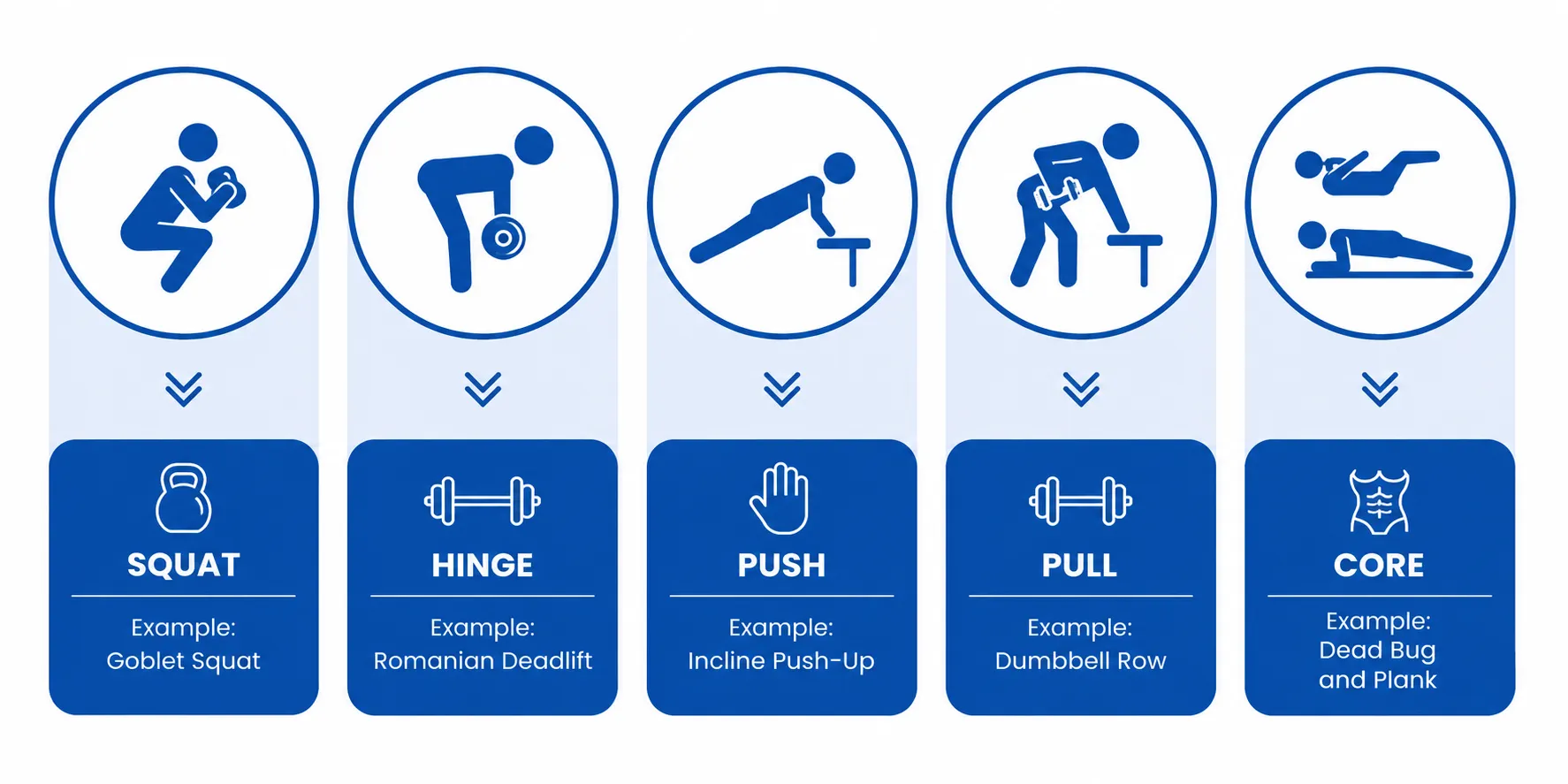
Every effective beginner program for women in perimenopause is built around five movement patterns. Master these, and you have 90% of what you need.
1. Squat pattern
Examples: goblet squat (holding a dumbbell at chest), bodyweight squat, box squat (squat to a sturdy bench or box). Trains quads, glutes, core. Sets the foundation for almost every functional movement.
2. Hinge pattern
Examples: Romanian deadlift with dumbbells, good morning, kettlebell deadlift. Trains hamstrings, glutes, lower back. Most under-trained movement in women and the one that protects the back most effectively.
3. Push
Examples: incline push-up (hands on counter), dumbbell shoulder press, chest press with dumbbells. Trains chest, shoulders, triceps.
4. Pull
Examples: dumbbell row, banded row, lat pulldown (if you have access to a cable machine). Trains back, biceps, and rear shoulders. The other most under-trained movement and the one that fixes most posture issues.
5. Core work
Examples: dead bug, bird dog, plank, side plank. Trains the deep core (which is more important than the visible abs). Add a couple of sets at the end of each session.
"I have started hundreds of women on strength training in their 40s and 50s, and the single biggest predictor of success is whether they show up consistently for the first 12 weeks. Consistency at moderate intensity beats intensity without consistency, every time." Suzanne Harden, Perimenopause and Menopause Fat Loss and Strength Coach
The Beginner Program (Weeks 1 to 12)
Two sessions per week, separated by at least one day of rest. Same template both days. Adjust weight as you progress.
Each session, in order
- Warm-up: 5 minutes of light movement (walking, arm circles, hip circles, gentle squats).
- Squat pattern: 3 sets of 8 to 10 reps.
- Hinge pattern: 3 sets of 8 to 10 reps.
- Push: 3 sets of 8 to 12 reps.
- Pull: 3 sets of 8 to 12 reps.
- Core: 2 to 3 exercises, 30 to 60 seconds each, 2 to 3 rounds.
Progression
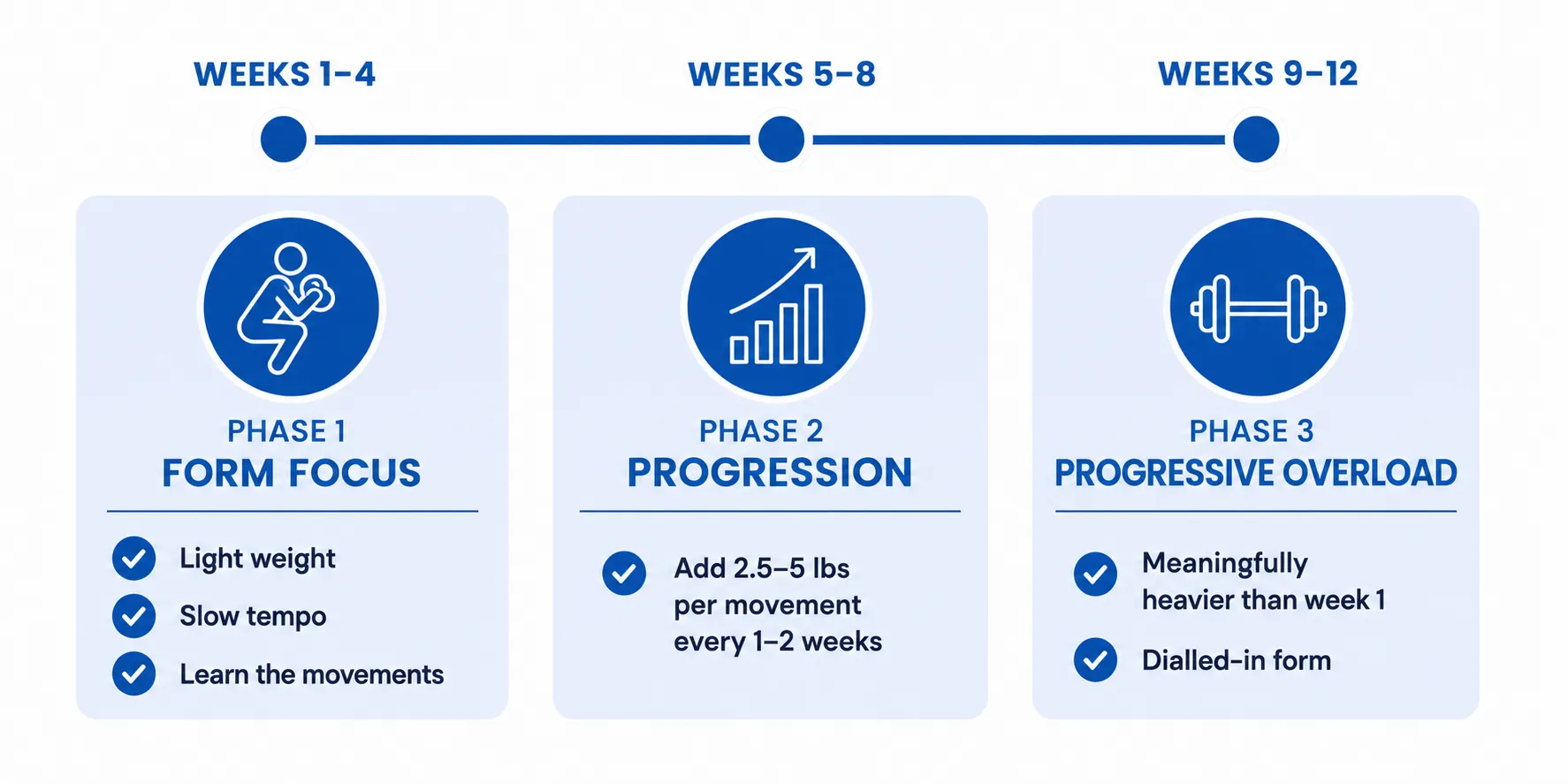
- Weeks 1 to 4: focus on form. Light weight, slow tempo. Get comfortable with the movements.
- Weeks 5 to 8: add weight or reps when the prescribed range feels easy. Aim to add 2.5 to 5 pounds per movement every 1 to 2 weeks.
- Weeks 9 to 12: continue progressive overload. By week 12, you should be using meaningfully more weight than week 1 and have a clear feel for what good form looks like.
www.gfitwellness.ca/online-fitness-coaching-winnipeg
Home Setup vs Gym
Both work. Choose the one you’ll actually use.
Home setup (minimum viable kit)
- Two pairs of adjustable dumbbells (or a set of fixed dumbbells from 5 to 30 lbs).
- A sturdy bench or chair.
- Optional: a resistance band, a yoga mat, a kettlebell.
- Total cost: $200 to $500 one-time, depending on what you already have.
Gym (minimum viable approach)
- A gym with dumbbells up to 50 lbs, a squat rack or Smith machine, cable machines.
- A clear plan you bring with you (the 5-movement structure above).
- YMCA, community centres, GoodLife, GYMVMT, or any neighborhood gym in Winnipeg works.
- Optional first month: one or two introductory sessions with a personal trainer to lock form.
Common Beginner Concerns
I don’t want to get bulky
You won’t. Women have roughly 10 to 30 times less testosterone than men and do not naturally build large amounts of muscle. The visible result of consistent strength training in women is a leaner, firmer body composition at the same scale weight, not bulk. The image of a bulky female bodybuilder is the result of years of specific training, nutrition, and often supplementation that beginner strength training simply does not produce.
I have a bad knee, back, hip
Most existing injuries do better with appropriate strength training than without. A coach can adapt the movements to work around any specific limitation. The exception is an acute injury or post-surgical rehabilitation, which warrants clearance from a physician or physiotherapist first.
I’m too out of shape to start
Untrue! Strength training is one of the most appropriate starting points for any fitness level, especially in midlife. Beginners produce the fastest strength gains and the most rapid improvements in metabolic and bone health markers. Starting in week 1 in your worst shape is exactly when the upside is biggest.
One of our Winnipeg clients, Susan, was 52 and had never lifted weights when she started with us. By week 8 she was deadlifting 115 pounds for sets of 8 with clean form. By week 24 she was deadlifting 145 pounds, her body composition had visibly changed, and she reported feeling more energetic than she had in 10 years. And the best part? Her doctor flagged improved bone density on her next DEXA. https://www.gfitwellness.ca/perimenopause-menopause-weight-loss-coaching-winnipeg#program
Want a coach to build your first 12 weeks?
Book a free 15-minute consult with our Winnipeg coaching team. We'll build your beginner program for your equipment and schedule, and confirm your insurance coverage on the call.
Frequently Asked Questions
Two to three full-body sessions per week, separated by at least one day of rest. Two sessions is the minimum effective dose; three is better if your schedule allows. More than four full-body sessions per week is generally diminishing returns and increases injury risk for beginners.
Heavy enough that the last 2 reps of each set feel hard but not impossible, with good form. For most beginners, that’s going to land somewhere between 5 to 20 pounds on dumbbell movements in the first 4 weeks. Progress 2.5 to 5 pounds every 1 to 2 weeks as your strength improves and the weight starts to feel easy.
Yes. A set of adjustable dumbbells (or a few fixed pairs), a bench or chair, and the 5-movement structure above produces 90% of the result you would get in a gym. Many of our most consistent Winnipeg clients have never set foot in a gym.
No, but it can help. One or two sessions with a trainer or coach to lock down form on the basic movements is a worthwhile investment. After that, a structured program and consistency does more than ongoing trainer sessions for most beginners.
Strength gains begin within the first 2 weeks (neurological adaptation). Visible body composition changes typically start at 6 to 8 weeks and become obvious by week 12. Metabolic improvements (insulin sensitivity, blood pressure, lipids) typically show on bloodwork by 12 to 16 weeks. Bone density changes take around 6 to 12 months to register on DEXA.





Book a call with our Wellness Coordinator to learn more


