
Why Calorie Counting Stops Working in Perimenopause

You counted calories in your 30s, and it worked. You did it for a few months, you lost the weight, and you moved on with your life. Then your 40s arrived, and the same approach suddenly seemed to produce no results. You tracked harder. You ate less. The scale moved a little, then stalled, then crept back. You blamed your discipline. But the discipline wasn’t the problem. Calorie counting works differently in perimenopause, for reasons that have nothing to do with willpower. This article explains why, and what to do instead.
Here’s the short version. Calorie counting in perimenopause runs into three problems at once: metabolic adaptation that drops your maintenance number faster than your calorie cuts can keep up, accelerated muscle loss that lowers the metabolic floor further, and hormone-driven hunger that makes the deficit harder to maintain. The alternative is to anchor the plan around protein, training, sleep, and the four other levers that actually respond to perimenopausal biology, with calorie tracking as a verification tool, not the central lever.
Counting calories and the scale still won’t move?
Book a free 15-minute consult with our Winnipeg menopause coaching team. We'll build a plan that works for perimenopausal biology and confirm your insurance coverage on the call.

Why Calorie Counting Stops Working After 40
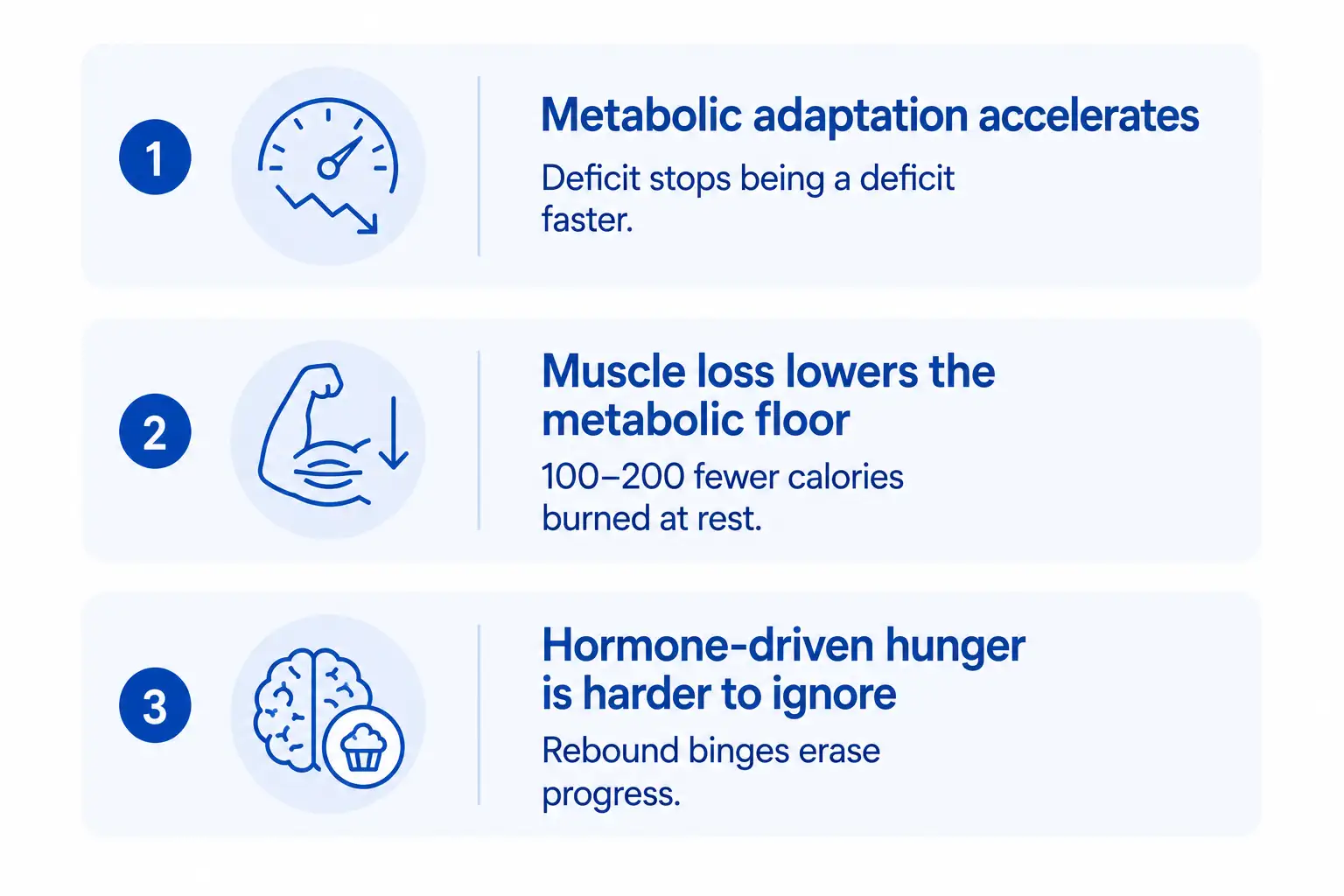
1. Metabolic adaptation accelerates
In a calorie deficit, your body adapts by dropping its energy expenditure. Cortisol creeps up, thyroid output dips, and your NEAT (non-exercise activity) quietly drops. This happens at every age, but the adaptation is faster and more pronounced in perimenopause. The deficit you started with stops being a deficit faster than it used to. The 500-calorie-below-maintenance plan that produced steady weight loss in your 30s now produces stagnation in your 40s within just 4 to 8 weeks.
2. Muscle loss lowers the metabolic floor
Accelerated muscle loss in perimenopause means your baseline metabolic rate is dropping while you are trying to count to a target that no longer matches your physiology. A woman who has lost 10 pounds of muscle between 40 and 50 is burning roughly 100 to 200 fewer calories at rest than she used to. Her calorie target needs to be lower than her old self's, and her muscle preservation needs to be more active than ever.
3. Hormone-driven hunger is harder to ignore
Declining estrogen affects satiety signalling. Disrupted sleep raises ghrelin. Elevated cortisol drives cravings. The deficit that was uncomfortable in your 30s is now actively painful. You can hold it with white-knuckle willpower for a while, but the rebound binge that almost always follows erases the deficit faster than the deficit produced loss.
Combine all three, and the calorie counting approach you knew is misaligned with the body you now have.
"My most common client question is 'why is the math not working anymore?' But the truth is, the math isn’t actually the problem. The variables have changed, but the equation hasn't. Once we update the inputs, the math suddenly works again." Chantelle Harvey-Houghton, GFIT Body Recomp and Life Stage Coach for Women
The Alternative: Anchor on Inputs, Verify with Calories
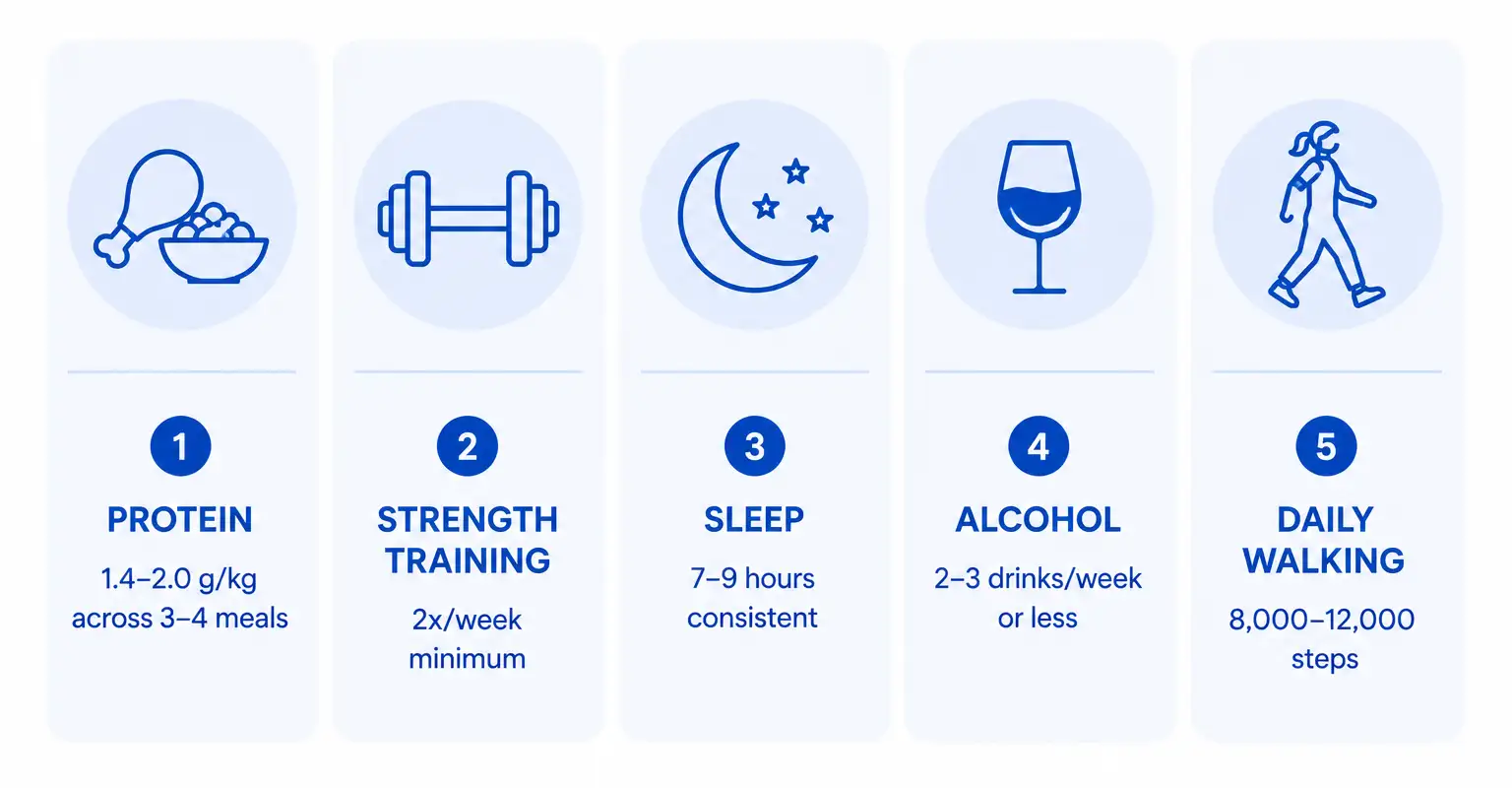
The alternative is not to stop tracking entirely - tracking is still useful as a verification tool. But the central lever shifts from "hit a calorie target" to "hit the inputs that match perimenopausal biology, then use calorie tracking to confirm."
The 5 inputs that matter most
- Protein at 1.4 to 2.0 g/kg per day, distributed across 3 to 4 meals.
- Strength training twice per week minimum.
- Sleep at 7 to 9 hours, consistent timing.
- Alcohol at 2 to 3 drinks per week or less.
- Daily walking, 8,000 to 12,000 steps.
These are the inputs that the perimenopausal body responds to. If all five are in place consistently for 12 weeks, weight loss typically follows without aggressive calorie restriction. If they are not in place, no amount of calorie counting will compensate.
Where calorie tracking still helps
Calorie tracking is useful in two specific contexts in perimenopause:
- As a 3-day audit when the scale stalls. Honest tracking surfaces hidden calories that have crept in (coffee additions, weekend drift, restaurant portions). Often the audit alone breaks the plateau.
- As a verification check when starting a new phase. Track for 1 to 2 weeks to confirm your actual intake matches your plan, then return to anchor-on-inputs tracking.
What does not work in perimenopause:
- Continuous daily calorie tracking with a tight deficit target as the central plan. The metabolic and behavioural costs outweigh the benefit at this life stage.
- Apps that suggest aggressive deficits (1,200 to 1,400 calories per day for adult women). These often produce worse outcomes than moderate deficits.
- Negative-emotion-driven tracking. If tracking is increasing food anxiety or disordered patterns, it has become a liability.
www.gfitwellness.ca/online-nutrition-coaching-winnipeg
What Maintenance Looks Like with the Input-Anchored Approach
Most of our perimenopausal coaching clients move through three phases:
Phase 1: Establish the inputs (weeks 1 to 8)
Focus on getting all five inputs in place consistently. Track food loosely (not to a target, just to build awareness). Most women lose 4 to 8 pounds in this phase from input changes alone, without conscious calorie restriction.
Phase 2: Gentle deficit if needed (weeks 9 to 20)
If continued weight loss is the goal, add a modest deficit (200 to 400 calories below estimated maintenance, not 500 to 800). Tracked enough to verify, not obsessed over. Protein and strength training stay constant.
Phase 3: Maintenance and reverse (week 20 onward)
Once the desired weight is reached, gradually add calories back to maintenance over 4 to 8 weeks. This is outlined in the reverse diet protocol. Tracking shifts to weekly verification rather than daily monitoring.
www.gfitwellness.ca/blog/how-to-reverse-diet
When Tracking Has Become a Problem
For some women, calorie tracking has become a 20-year habit that is no longer serving them. Three signs it is time to step back from daily tracking:
- You feel anxiety when you cannot track a meal.
- Restaurant meals, social events, or unfamiliar foods produce significant stress.
- You are using tracking to justify increasingly restrictive eating patterns.
If any of these apply, working with a coach (and possibly a therapist) to transition off daily tracking is worth considering. The goal is not to never track again. The goal is to use tracking as a tool when useful and put it down when it is not.
One of our Winnipeg clients, Ruth, had tracked calories daily for 15 years. At 49, the tracking was no longer producing results and was producing visible food anxiety. We stopped daily tracking entirely for 90 days, and instead focused on protein, strength training, sleep, and reducing alcohol. She lost 6 pounds in three months without tracking a single calorie. More importantly, she described feeling free around food for the first time in years. We reintroduced tracking as a 3-day quarterly audit instead of a daily practice.
Want to move beyond calorie counting?
Book a free 15-minute consult with our Winnipeg menopause team. We'll build an input-anchored plan that fits your stage and confirm your insurance coverage on the call.
Frequently Asked Questions
Not entirely, but the role should shift. Daily calorie tracking with a tight deficit as the central plan typically stops working in perimenopause, but calorie tracking as a verification tool (a 3-day audit when the scale stalls or a 1- to 2-week check at the start of a new phase) remains useful. The central plan should anchor on the 5 inputs (protein, strength training, sleep, alcohol, daily walking) that perimenopausal biology actually responds to.
There is no single number. As a starting estimate, multiply your bodyweight in pounds by 11 to 13 for a moderate deficit. For a 165-pound woman, that is 1,800 to 2,150 calories. This is a starting point, not a prescription. Adjust based on results over 4 to 6 weeks. Aggressive deficits below bodyweight x 10 typically backfire in perimenopause.
Three reasons combined: metabolic adaptation drops your maintenance faster than your deficit can keep up, accelerated muscle loss lowers your baseline, and hormone-driven hunger makes the deficit harder to hold. The old diet was calibrated to a body that no longer exists. The fix is to calibrate to your current body, with an input-anchored approach rather than a calorie-anchored approach.
For some women, yes, but for many it’s not. A modest fasting window (12 to 14 hours overnight) is generally fine. Longer fasting windows (16:8, 18:6, OMAD) often worsen cortisol, sleep, and binge cycles in perimenopausal women. If fasting has been working for you, continue. If it is producing fatigue, sleep disruption, or rebound eating, switch to a shorter window.
Signs of too aggressive a deficit in perimenopause: weight loss has stalled, sleep has worsened, energy is low, workouts feel harder than they should, you are colder than usual, your hair is shedding more, or your period has become irregular. Three or more of these signals usually means the deficit is too steep and a maintenance phase, refeed or diet break is in order.





Book a call with our Wellness Coordinator to learn more


