
How to Reverse Diet Without Gaining Weight Back

So you hit your goal weight. Congratulations! That’s an amazing accomplishment. But now what? You can’t "just eat normally again”. That’s exactly how you got into trouble in the first place. But you also can’t diet forever. The truth is that the period immediately after a successful fat loss phase is more delicate than the loss itself. Eating "normally" without a plan is how most people regain. Reverse dieting is the alternative. Done properly, it’s how you maintain your results, restore your metabolism, and avoid the eight-week rebound that ruins most diets.
Here is the short version: A reverse diet is a planned, gradual increase of calories from your deficit back to your maintenance level over 4 to 12 weeks. You add approximately 100 calories per week (mostly from carbs), monitor weight and measurements weekly, and stop when you reach your new optimal maintenance intake. Done well, you preserve almost all of your fat loss while restoring metabolic rate, hormones, hunger signalling, energy, and training capacity. This article is your blueprint for reverse dieting.
Just hit your goal and afraid of regaining?
Book a free 15-minute consult with our Winnipeg reverse diet coaching team. We'll calculate your estimated maintenance calories, build your 8-week reverse schedule, and confirm your insurance coverage on the call.

What a Reverse Diet Actually Is (And What It Is Not)
A reverse diet is a structured, gradual add-back of calories at the end of a fat loss phase, designed to:
- Restore your metabolic rate.
- Reset hunger and satiety hormones (ghrelin, leptin) that have shifted during prolonged dieting.
- Restore training performance, recovery, and energy.
- Restore sleep quality, mood, libido, and the other quiet quality-of-life metrics that suffer during long deficits.
- Allow you to maintain your new weight at the highest possible calorie intake.
A reverse diet is not:
- A fat gain plan. The goal is maintaining your new body composition, at a higher caloric intake.
- Permission to eat whatever you want; it is a structured, tracked phase, just at a higher intake.
- A magic bullet. If you ignore protein, training, or sleep during the reverse, fat regain is inevitable.
Why "Just Eat Normally" Fails
Three reasons the "just eat normally" approach almost always ends in regain:
1. Your metabolism is now lower than it was
After 12 to 24 weeks of a caloric deficit, your resting metabolic rate has dropped. Hormones (thyroid, leptin) are suppressed, NEAT is lower, and your daily energy expenditure is 200 to 500 calories below where it started. The intake that you could maintain your weight at before will now cause weight gain at your new, lower body weight.
2. Your hunger hormones are out of control
Ghrelin (the hunger hormone) is elevated after prolonged dieting, and leptin (the satiety hormone) is suppressed. When you remove the deficit and start eating more, hunger does not normalize for 4 to 12 weeks. You will predictably feel hungrier, and overeating becomes very easy.
3. Your habits include restriction
During a deficit, you have built habits around restriction: avoiding restaurants, skipping social occasions, white-knuckling cravings. And when you exit the deficit, those habits tend to collapse all at once. Without a structured plan for what "normal" eating should look like at maintenance, the swing toward unrestricted eating tends to overshoot, creating a recipe for regain.
"Almost every client I work with on a reverse diet has done the same thing numerous times before: hit their weight loss goal, eaten "normally" for 4 to 6 weeks, regained 8 to 12 pounds, panicked, and started cutting again. The reverse diet breaks that loop and helps us maintain results. We add the calories back deliberately, the body responds, and the fat loss holds." Lana Jankovic, Fat Loss Coach for Midlife Women
The GFIT 8-Week Reverse-Diet Protocol
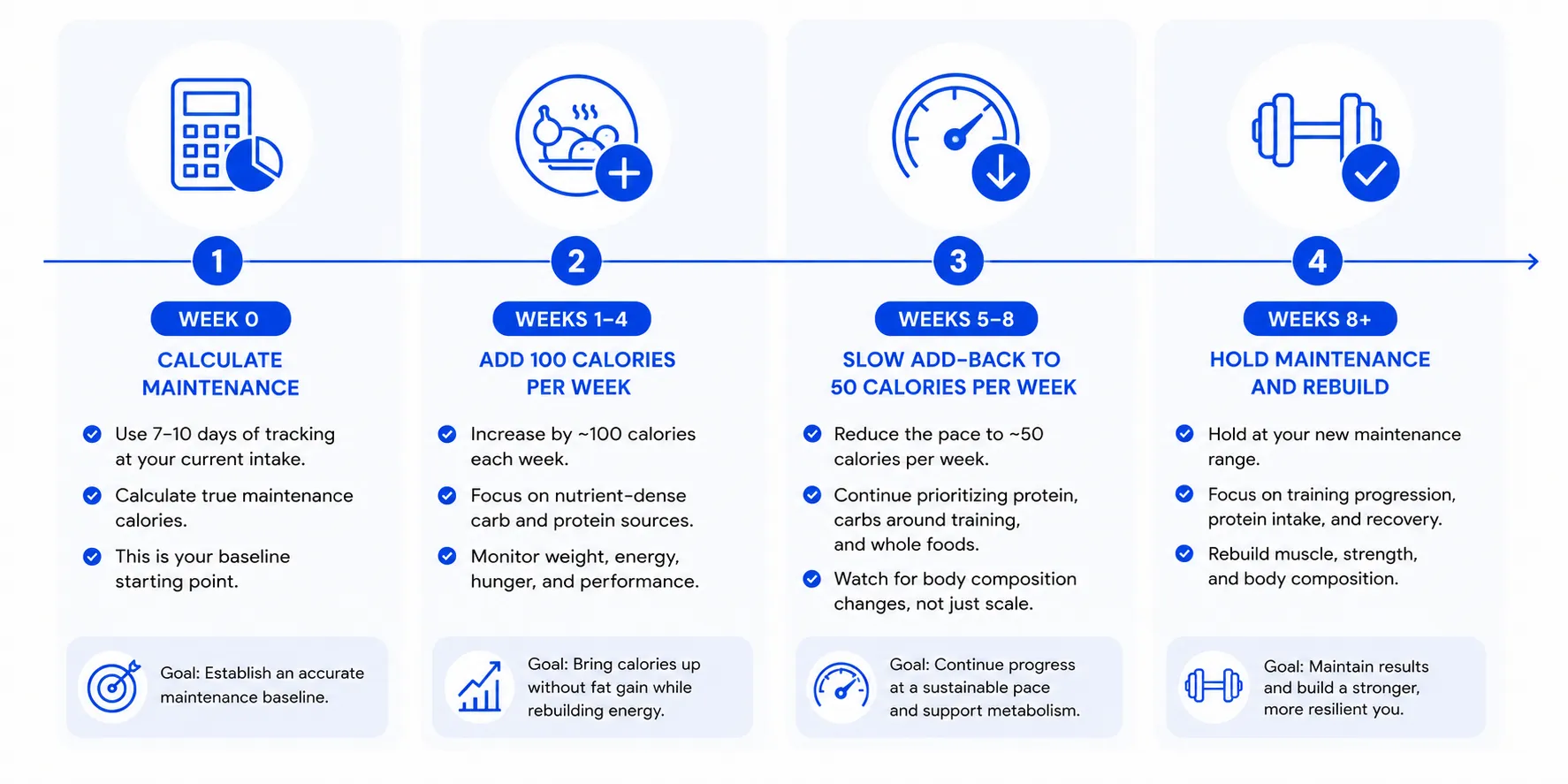
The GFIT 8-Week Reverse-Diet Protocol is the structure we use with most clients at the end of a fat loss phase. Note you’ll need to adjust the duration to your specific deficit history (longer deficits = longer reverses).
Week 0: Calculate your starting maintenance estimate
Multiply your bodyweight in pounds by 13 to 15. For a 165-pound woman who has been dieting for 4+ months, start at 13 (about 2,150 calories). For a 165-pound woman who has been dieting briefly, start at 14 (about 2,310). This is your maintenance target.
Your current deficit intake is probably 300 to 600 calories below this. The reverse diet bridges that gap over 4 to 8 weeks.
Weeks 1 to 4: Add approximately 100 calories per week
Each week, add 100 calories to your daily total, mostly from carbohydrates (think rice, potatoes, oats, fruit). Keep protein constant. Keep fats roughly constant. Walking and training should stay the same.
Weigh in daily, and use your weekly average. Take measurements weekly, too. Expect 1 to 3 pounds of scale increase across these four weeks, which is mostly muscle glycogen, water retention, and digestive volume returning to normal. This is healthy and expected. It is not fat gain.
Weeks 5 to 8: Slow the add-back and monitor
By week 4, you should be close to your maintenance estimate. You can slow the add-back to 50 calories per week, or pause for a week to verify that your weight is stabilizing. If weight is dropping at the higher intake, that is information: your maintenance is higher than the estimate, and you should keep adding. If weight is climbing more than 1 pound per week, hold the current intake for 2 weeks until your body adjusts.
Weeks 8+: Hold maintenance and rebuild
Once weight is stable at your new intake for 2 consecutive weeks, you have found your true maintenance. Stay there for 8 to 12 weeks before considering another deficit phase. This is where metabolic recovery, hormonal recovery, and habit rebuilding actually happen.
The 5 Non-Negotiables During a Reverse
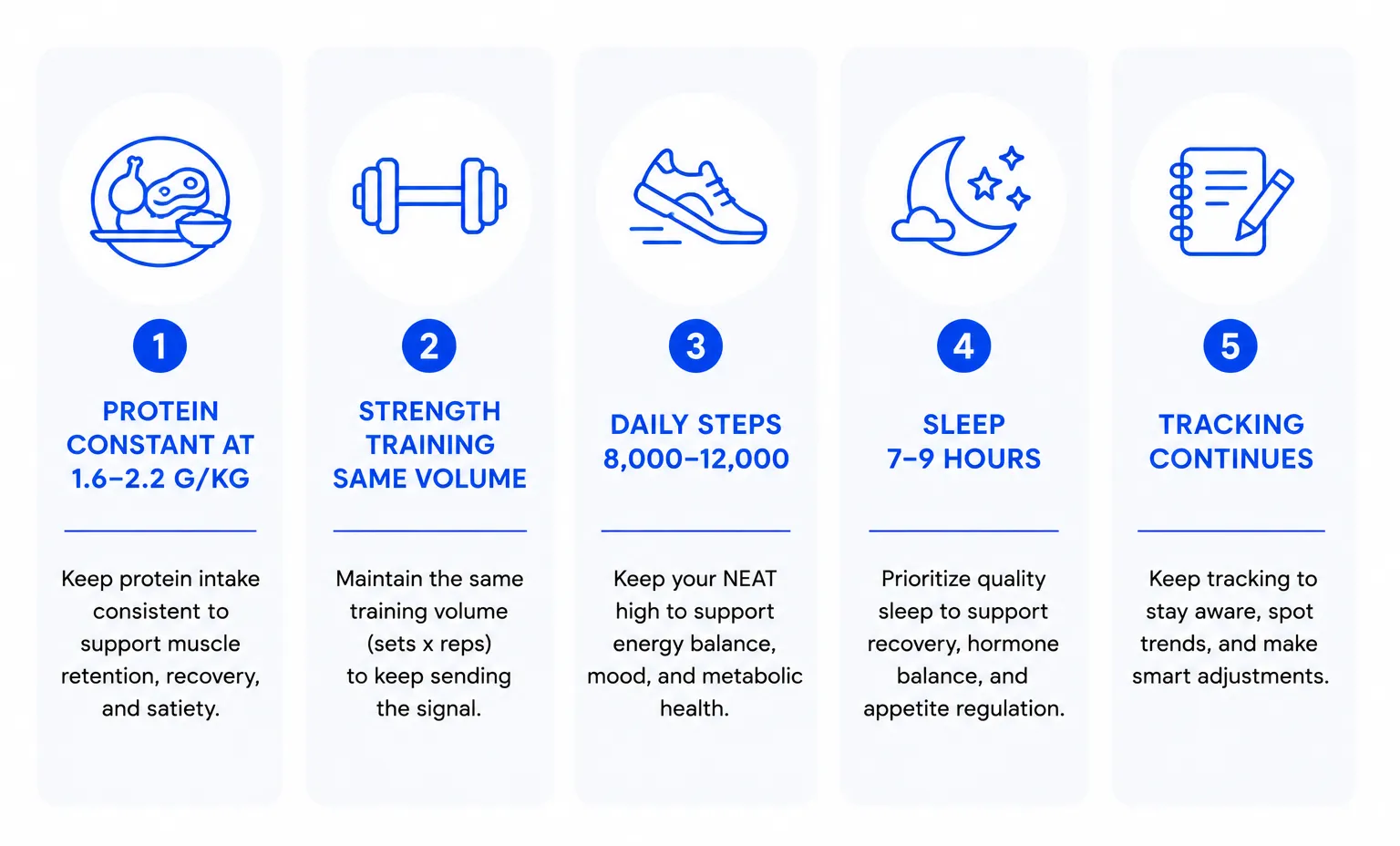
The 5 non-negotiables during a reverse diet: protein constant at 1.6 to 2.2 g/kg, strength training same volume, daily steps 8,000 to 12,000, sleep 7 to 9 hours, tracking continues for the full reverse.
- Protein stays constant at 1.6 to 2.2 g/kg per day. Protein is what protects muscle and curbs hunger as we add carbs back.
- Strength training continues at the same volume. This ensures the extra calories will mostly be partitioned towards building muscle.
- Daily steps stay at 8,000 to 12,000.
- Sleep stays at 7 to 9 hours. Be disciplined with this! Skipping sleep undermines everything else.
- Tracking continues for the full reverse. Stopping tracking is the most common reason reverses fail.
Common Reverse Diet Mistakes
- Adding calories too fast (200+ per week). The body cannot adapt that quickly, and most of the extra goes to fat.
- Stopping tracking the day after hitting your goal weight. This is the most predictable cause of regain.
- Dropping training intensity. Less training plus more food equals fat gain.
- Treating the reverse as "maintenance is for later, eat whatever now." The reverse is the actual maintenance work.
- Not planning for social settings. Restaurants, drinks, holidays all = volatility. Plan around them, at least until we’ve reached maintenance calories.
One of our Winnipeg clients, Rachel, finished a 7-month fat loss phase down 32 pounds. We reverse dieted her over 8 weeks, and by week 8 she was eating 2,400 calories a day, up from 1,650. Her weight settled 1.4 pounds above her finish weight, coming almost entirely from water and glycogen (which we knew by tracking her body fat percentage and measurements). Six months later, she was still within 2 pounds of her goal, eating 2,400 calories a day and now putting on lean muscle week after week.
When to Bring in a Coach
DIY reverse diets work for experienced trackers with steady life schedules. Be honest, is that you? Here are three signs you may want to bring in a coach:
- You have regained weight after every previous diet you have done.
- You are afraid to add calories because every attempt at "eating more" turned into a binge.
- You want accountability through the first 12 weeks, which is the highest-attrition window.
At GFIT, our reverse diet coaching is built specifically for this transition. Most Winnipeg clients are insurance-covered through Manitoba Blue Cross, Canada Life, Sun Life, Manulife, or Green Shield, which usually means little to no out-of-pocket cost.
Add calories back without regaining
Book a free 15-minute consult with our Winnipeg reverse diet team. We'll build your 8-week reverse schedule, set your maintenance target, and confirm your insurance coverage on the call.
Frequently Asked Questions
Roughly half as long as the deficit phase it follows. A 12-week diet = approximately a 6-week reverse. A 24-week diet = an 8 to 12-week reverse. Shorter reverses prevent metabolic recovery; longer reverses provide diminishing returns.
You will see 1 to 5 pounds of scale increase across the reverse from muscle glycogen, water, and digestive volume returning to normal. This isn’t fat gain, and it’s healthy and expected. Remember, not all weight gain = fat gain. Fat gain only happens if you add calories too aggressively or stop tracking.
Mostly carbs. Carbohydrates are the most metabolically responsive macronutrient (they raise leptin, thyroid output, and training capacity more than fats), and they tend to be the most depleted at the end of a long deficit. Fats stay roughly constant; carbs lead the add-back.
Yes, and you should! The appetite rebound after GLP-1 cessation creates the same kind of restrictive-to-overeating swing that ruins most diets. A structured reverse adds calories deliberately, tracks against scale and measurements, and protects your fat loss. See our coming off Ozempic article for the full GLP-1 taper plan.
Hold your current intake for 2 weeks rather than dropping calories or going back to a deficit. Remember that most scale gain in the first 4 weeks is water and glycogen, not fat. If your weight is climbing more than 1 pound per week for 2 consecutive weeks at the same intake, hold and reassess. A coach can help diagnose whether the gain is really fat or just byproducts of adding food.




.webp)
Book a call with our Wellness Coordinator to learn more


