
Nutritional Periodization: The Science-Backed Framework Behind Every GFIT Transformation
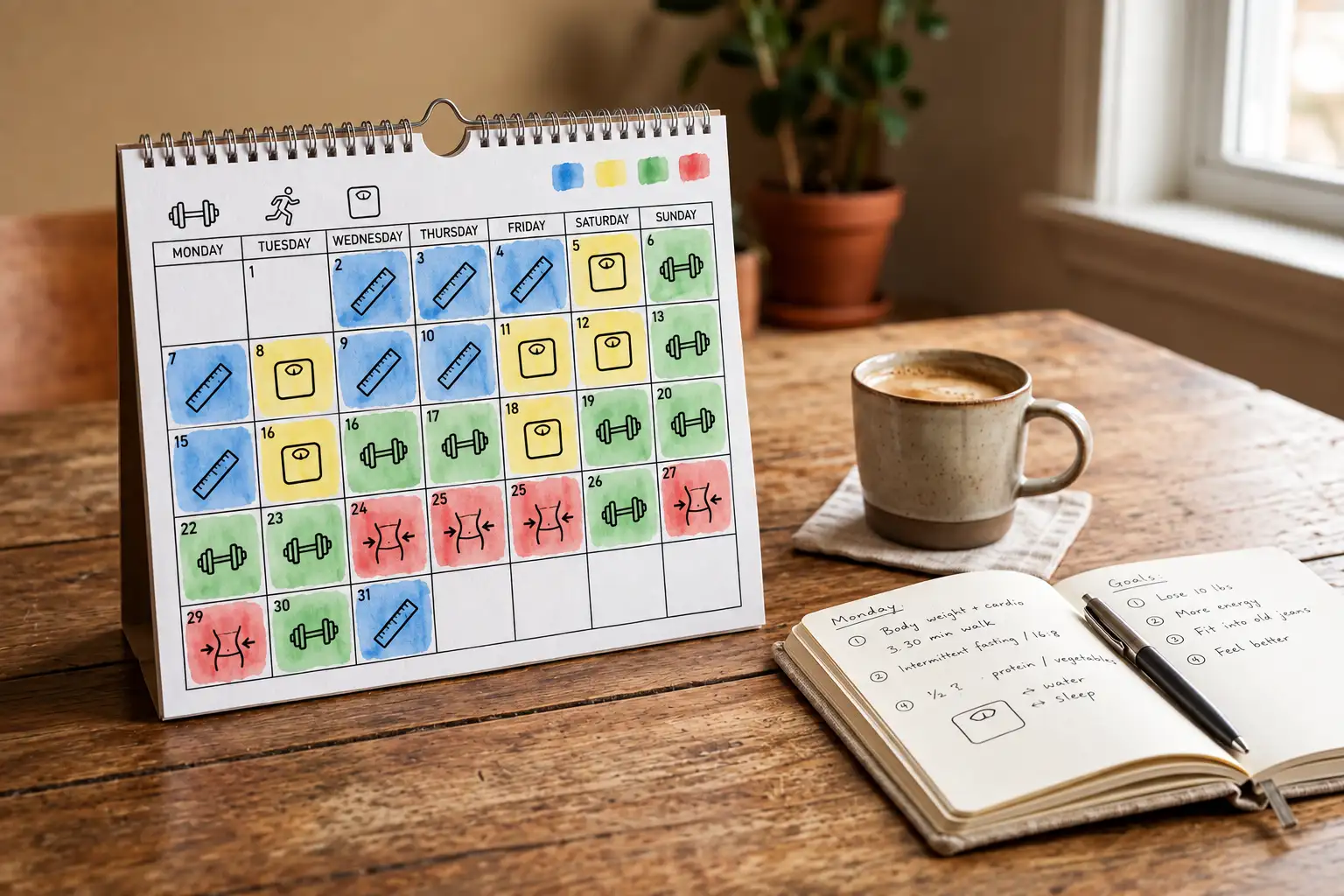
Every diet works... for a while. The reason most people bounce between fat loss attempts and weight regain is not that they keep picking the wrong diet. It is that they are missing the concept the fitness industry rarely talks about: periodization. Elite athletes have known for decades that continuous training at the same intensity plateaus and then regresses. Continuous dieting works the same way. The GFIT Nutritional Periodization framework treats fat loss, muscle building, and maintenance as distinct phases that cycle over the calendar year rather than a permanent deficit. This is why our clients actually keep their results, while most of the fitness industry watches theirs rebound.
There are 8 distinct nutritional phases in the GFIT framework: Primer, Fat Loss, Diet Break, Reverse Diet, Building, Maintenance, Mini-Cut, and Recomposition. Each has a specific calorie intake range, duration, and desired outcome. Rather than dieting continuously, GFIT clients cycle through phases matched to their current life stage, goal, and biofeedback. Most clients spend more of their year in maintenance and building phases than in fat loss phases, which is the opposite of how most people approach weight loss and is precisely why our clients maintain their results.
Stuck in the diet-and-rebound cycle?
Book a free 15-minute consult with our Winnipeg coaching team. We'll map your current phase, plan your next 3 to 6 months, and confirm your insurance coverage on the call.

Why Continuous Dieting Fails
A typical fat loss attempt looks like this: 12 weeks of a moderate deficit produces 8 to 15 pounds of loss. Adherence fades. The diet is abandoned. Old habits return. Weight is regained within 6 to 12 months. Then the cycle repeats, sometimes for decades.
The reason this pattern is so predictable is actually biological. When the body detects a caloric deficit lasting 8 weeks or more, three protective adaptations kick in:
- Metabolic rate drops (thyroid output decreases, NEAT quietly reduces, resting energy expenditure drops by 100 to 300 calories per day).
- Hunger hormones amplify (ghrelin rises, leptin falls, the food noise gets louder).
- Psychological reserves deplete (decision fatigue, food fixation, restriction-rebellion cycles build).
None of these adaptations are personal failures. They are the body doing exactly what evolution designed it to do when it perceives famine.. The problem is that dieting looks a lot like famine to the body, and the body will win a willpower contest against your prefrontal cortex every time.
The GFIT framework solves this by working with biology instead of against it. Instead of extending the deficit indefinitely and hoping willpower holds, we cycle. Deficit phases have a defined endpoint; recovery phases are built in. Building phases follow. Maintenance is a real practiced skill, not an afterthought.
The 8 GFIT Nutritional Phases
Each phase serves a specific purpose. Understanding them individually is the foundation for understanding how they combine.
Phase 1: Primer
Duration: 2 weeks to 6 months. Calorie intake: maintenance or slight deficit. Purpose: improve habits and mindset, raise metabolic rate and hormone function, recover from a previous diet.
Most people skip this phase and jump straight into a deficit, and that is a big mistake. The Primer phase does the unglamorous foundational work: building consistent meal timing, hitting protein targets, sleeping properly, walking daily, and settling the metabolic system that a previous diet may have suppressed. Clients who complete a Primer phase produce dramatically better fat loss outcomes when they subsequently enter a deficit.
Phase 2: Fat Loss
Duration: 6 to 18 weeks. Calorie intake: deficit. Purpose: lose fat at a rate of 0.5 to 1% of bodyweight per week while preserving muscle mass.
This is what most people think of as "a diet." It is one phase in a larger cycle, not the entire framework. Duration is capped at 18 weeks specifically to avoid the metabolic and psychological cost of longer continuous deficits.
Phase 3: Diet Break
Duration: 1 to 4 weeks. Calorie intake: maintenance. Purpose: improve diet adherence, decrease hunger, drop diet fatigue.
Inserted every 4 to 8 weeks during a longer fat loss phase, or as a distinct phase between the Fat Loss and Reverse Diet phases. The Diet Break restores hunger and satiety hormones, gives the client a psychological reset, and often produces the biggest "whoosh" of weight loss right after the break ends because the metabolic adaptation partially reverses.
Phase 4: Reverse Diet
Duration: 3 to 8 weeks. Calorie intake: maintenance (with gradual add-back). Purpose: improve biofeedback, better fuel the body, arrive at a higher new maintenance intake.
The Reverse Diet is the structured exit from a fat loss phase. Calories are added back gradually (100 to 200 per week, mostly from carbs) while training stays constant. Done properly, this phase preserves nearly all of the fat loss while restoring metabolic rate, hormones, and training capacity. This is the phase almost every DIY dieter skips, which is why almost every DIY dieter rebounds. For the full step-by-step, see the reverse diet playbook.
Phase 5: Building
Duration: 3 to 12 months. Calorie intake: surplus. Purpose: build muscle, increase strength, improve training performance.
This is the phase most fitness content ignores. But muscle building requires a caloric surplus, and it takes months to years to produce meaningful gains. Clients who want body composition change (not just weight loss) must spend meaningful time in this phase.
Phase 6: Maintenance
Duration: 1 month to indefinite. Calorie intake: maintenance. Purpose: sustainable habits, "practicing maintenance," continued metabolic and hormonal health.
This is the phase most people never actually enter, and it is the phase where results are kept or lost long-term. Maintenance is a real skill that requires practice. The GFIT framework positions maintenance as the primary phase, with fat loss and building phases as tactical interventions inserted when needed.
Phase 7: Mini-Cut
Duration: 3 to 6 weeks. Calorie intake: deficit. Purpose: lose fat quickly (0.5 to 1% BW per week) to allow more time in a building phase.
The Mini-Cut is the strategic tool used within a longer building phase. If a client has been building for 6 months and has added meaningful muscle but also 5 pounds of fat, a 4-week Mini-Cut drops the fat and returns them to a building phase without losing the muscle gained.
Phase 8: Recomposition
Duration: 2 to 6 months. Calorie intake: slight deficit or slight surplus (near maintenance). Purpose: decrease body fat percentage, increase muscle, strength, and training performance simultaneously.
Recomposition works best for specific candidates: beginners, returners, or higher-body-fat lifters. Advanced lean lifters generally cannot recomp effectively and need dedicated Fat Loss and Building phases separately.
For the summary of all phases, see the GFIT Nutritional Phases Chart.
The client who transforms in the long run is not the one who dieted the hardest. It is the one who learned to cycle through phases. Deficit for 12 weeks, maintenance for 6 weeks, building for 6 months, another mini-cut, then back to maintenance. Something like that. That is what the body responds to, and that is what actually sticks. — Chantelle Harvey-Houghton, GFIT Body Recomp and Life Stage Coach for Women
How the Phases Combine Across a Year
A typical calendar year for a GFIT client might look like this:
- Weeks 1 to 4: Primer phase (establish habits, recover from holiday drift).
- Weeks 5 to 16: Fat Loss phase (spring cut).
- Weeks 17 to 20: Reverse Diet (add calories back over 4 weeks).
- Weeks 21 to 40: Maintenance and light Building (summer, life, travel).
- Weeks 41 to 44: Mini-Cut (brief fall reset).
- Weeks 45 to 52: Maintenance (holidays, indulgence phase built in).
Notice what this program does not include: a continuous 6-month deficit. Perpetual restriction. No fighting biology. The client spends most of the year at maintenance or in a mild surplus, with tactical fat loss inserted for 12 to 16 weeks. That is why the results compound over years rather than reverting.
Why This Framework Beats DIY Dieting
DIY dieters typically do one of two things:
- Diet forever, and rebound eventually when biology overwhelms willpower.
- Do a diet, hit their goal, "go back to normal eating," and rebound within 6 months.
Both fail for the same reason: no structured maintenance or reverse phase. The Nutritional Periodization framework replaces the diet-rebound cycle with a phased approach that respects biology and produces compound results over time.
The framework is not fast in the same way a 30-day challenge is fast. It is faster on a 5-year timeline than any 30-day challenge could ever be.
One of our Winnipeg clients, Alyssa, came to us after 12 years of the diet-rebound cycle. She had lost and regained roughly 40 pounds three times over. We stopped her from starting a fourth aggressive cut and instead put her through a 6-week Primer, then a moderate 14-week Fat Loss phase, then an 8-week Reverse Diet, and then 6 months of Maintenance. She lost 22 pounds during the cut phase. Two years later, she is still within 3 pounds of that finish weight. That is the difference our framework makes.
When to Bring in a Coach
Nutritional periodization is difficult to self-implement because it requires knowing which phase to be in, how long to stay, and when to transition. A qualified coach reads the biofeedback, sets the calorie targets for each phase, and makes the transitions at the right moments.
Three signs coaching is the right investment:
- You have rebounded from more than one previous diet.
- You have been dieting for 3+ months and results have stalled but you don't know whether to eat less, take a break, or reverse.
- You want body composition change (fat loss + muscle gain) rather than just weight loss on the scale.
Most of our Winnipeg clients are insurance-covered through Manitoba Blue Cross, Canada Life, Sun Life, Manulife, or Green Shield.
Ready to stop the diet-rebound cycle?
Book a free 15-minute consult with our Winnipeg coaching team. We'll assess where you are in the cycle, plan your next phases, and confirm your insurance coverage on the call.
Frequently Asked Questions
Nutritional periodization is the practice of cycling through structured nutrition phases (deficit, maintenance, surplus) matched to specific goals, rather than dieting continuously. The GFIT framework uses 8 phases: Primer, Fat Loss, Diet Break, Reverse Diet, Building, Maintenance, Mini-Cut, and Recomposition. Each phase has a defined calorie range, duration, and desired outcome.
The GFIT Fat Loss phase is capped at 6 to 18 weeks. Longer continuous deficits produce diminishing returns, worsen metabolic adaptation, and increase the risk of rebound. If you need to lose more fat after 18 weeks, the correct move is a Diet Break followed by a Reverse Diet and then another Fat Loss phase later, not push through the current deficit.
A Diet Break is 1 to 4 weeks at maintenance calories inserted during or after a longer fat loss phase. It restores hunger and satiety hormones, reduces cortisol, improves adherence, and often produces a whoosh of weight loss after the break ends because the metabolic adaptation partially reverses. Diet Breaks make longer-term fat loss more effective than continuous dieting.
Sometimes. This is called recomposition and works best for beginners, returners to lifting after a long break, or higher-body-fat individuals. Advanced lean lifters generally cannot recomp meaningfully and need dedicated Fat Loss and Building phases separately. Timeframe: 2 to 6 months of near-maintenance calories with high protein and progressive strength training.
Roughly every 4 to 8 weeks during an active Fat Loss phase. Insert a 1 to 2 week Diet Break at maintenance. Signs that a break is due: sleep worsening, energy dropping, cravings intensifying, weight loss stalling, or the scale not moving despite compliance. All of these are markers that hormonal adaptation has caught up with the deficit.





Book a call with our Wellness Coordinator to learn more


