
Estrogen and Belly Fat: Why Weight Settles Differently After 40

Clients often report that in their 20s and 30s, weight used to go to their hips and thighs. Then sometime in their 40s, they noticed something new: when they put weight on, their bodies started storing it in their midsections. You’re eating the same things, you’re training the same way, yet your body looks completely different. This isn’t random, and it isn’t a sign you’re doing something wrong. It’s estrogen, and it’s a hormone shift that actually has health implications that go beyond appearance. This article explains why it happens, why it matters, and what you can do about it.
Here’s the short version: as you age, declining estrogen directs fat storage toward the abdomen rather than the hips and thighs. And the fat that accumulates there is not just subcutaneous (under the skin) but also visceral (around the organs), and visceral fat is metabolically active in ways that drive insulin resistance, cardiovascular risk, and inflammation. The fix is not tons of cardio, crunches or waist trainers. It’s strength training, protein, sleep, fibre, and reducing alcohol. Done consistently, these make a massive difference.
Carrying weight around your middle that was never there before?
Book a free 15-minute consult with our Winnipeg menopause coaching team. We'll build a plan that targets the underlying drivers and confirm your insurance coverage on the call.

Why Estrogen Affects Fat Distribution
Estrogen has receptors throughout the body, including in adipose (fat) tissue. Higher estrogen levels in your reproductive years direct fat storage toward the hips, thighs, and breasts because this is biologically protective for reproduction: subcutaneous fat in these areas is metabolically quieter, and serves as energy reserves to make and feed babies.
As estrogen declines during perimenopause and remains low post-menopause, that directional signal weakens. Without the strong pull toward hip and thigh storage, fat is more likely to accumulate in the abdomen. And this shift can happen even without weight gain; many women report that their measurements change before their weight does.
Why Visceral Fat Is Different (And Why It Matters)
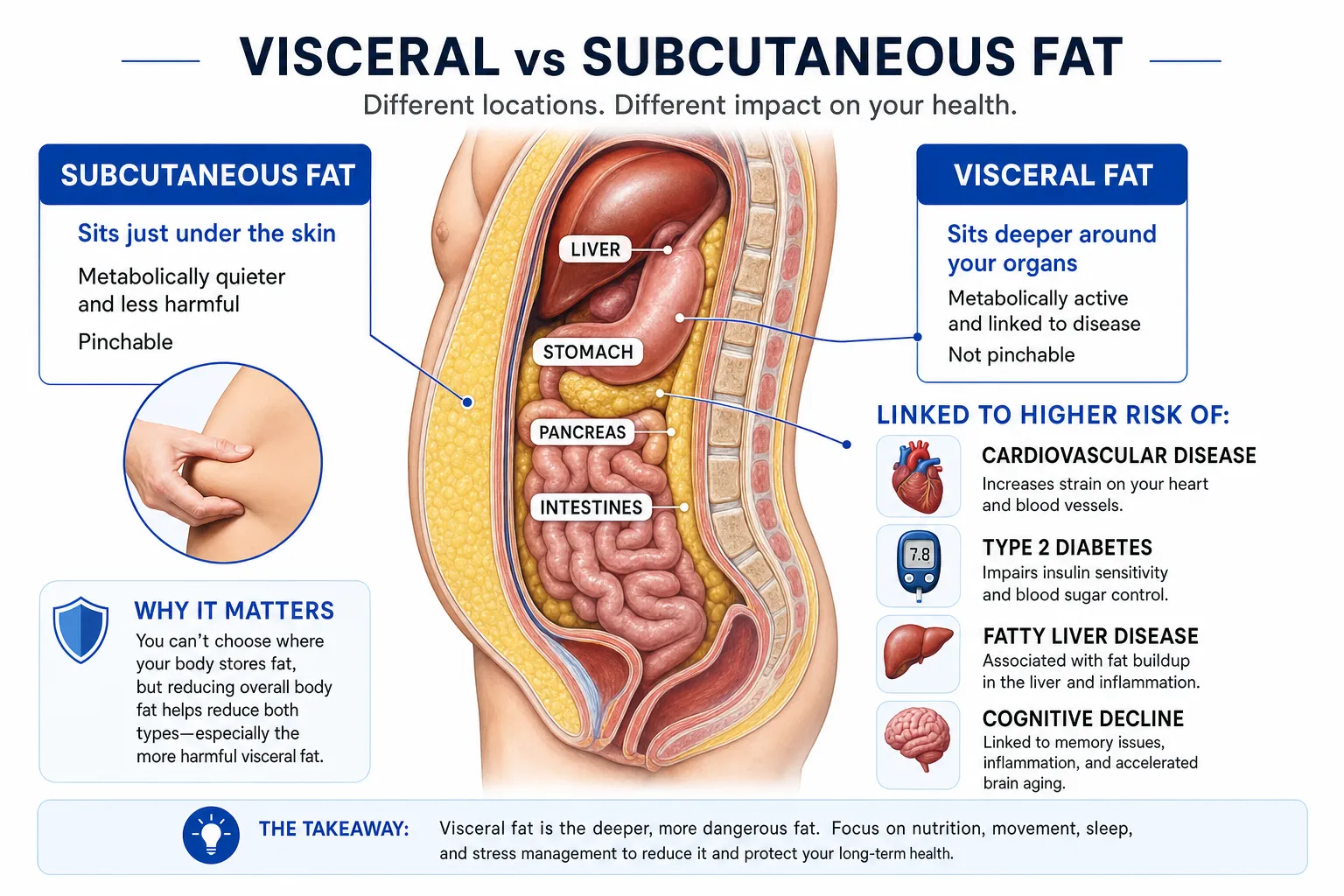
Visceral fat vs subcutaneous fat comparison: subcutaneous fat sits just under the skin and is metabolically quiet, visceral fat sits deep around the organs and is linked to cardiovascular disease, type 2 diabetes, non-alcoholic fatty liver disease, and cognitive decline.
Subcutaneous fat sits just under the skin. You can pinch it. It is what gives the body its shape; and it’s a metabolically quieter tissue.
Visceral fat sits deeper, around your organs (liver, intestines, pancreas). You can’t pinch it; it’s what creates the firm, protruding belly that does not respond to a few weeks of dieting, and it is metabolically very active. Visceral fat secretes inflammatory compounds, drives insulin resistance, and is independently linked to:
- Cardiovascular disease.
- Type 2 diabetes.
- Non-alcoholic fatty liver disease.
- Cognitive decline.
This is why midsection weight in your 40s and 50s isn’t a cosmetic concern. The mass that has redistributed is a metabolic risk factor. The good news? Visceral fat is also the most responsive fat to the right interventions.
"Many of my clients come in worried about how they look, but by our third meeting, the concern has shifted to what the midsection fat actually means for their long-term health. Visceral fat is the kind we most want to move, and I always educate my clients on why it matters." April Klippenstein, GFIT Certified Menopause Coaching Specialist
How to Measure It (Without Special Equipment)
You don’t actually need a DEXA scan to track visceral fat. Just take these two at-home measurements:
- Waist circumference at the navel. Above 80 cm (31.5 inches) in women is correlated with elevated visceral fat. Above 88 cm (34.5 inches) is high.
- Waist-to-hip ratio. Waist measurement divided by hip measurement. Above 0.85 in women is correlated with elevated cardiovascular and metabolic risk.
Take these monthly, first thing in the morning, and before eating. Know that these measurements are more sensitive to visceral fat changes than the scale is; many women lose visceral fat for months while the scale moves only slightly, because muscle is being preserved or built simultaneously.
What Actually Shrinks Visceral Fat
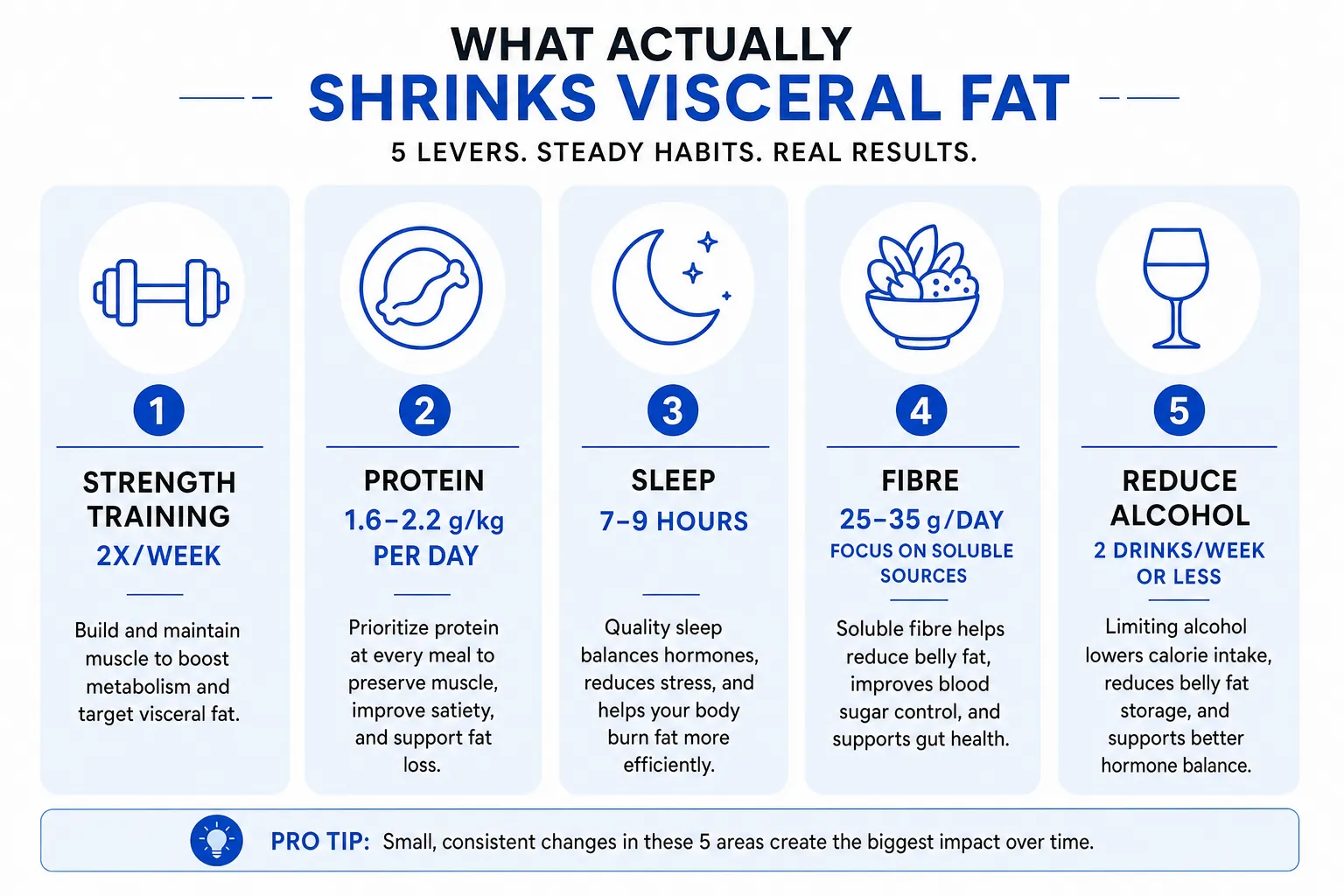
1. Strength training
This is your single highest-leverage intervention. Resistance training (twice per week, full body, compound movements) reduces visceral fat through multiple pathways: improved insulin sensitivity, increased muscle mass that sinks blood glucose, lower cortisol, and a higher resting metabolic rate.
2. Protein at every meal
Adequate protein (1.6 to 2.2 g/kg per day) protects muscle during fat loss and improves satiety, which makes the calorie management of visceral fat reduction easier. Low-protein diets in midlife consistently fail at visceral fat reduction.
3. Sleep
Visceral fat is uniquely sensitive to cortisol and disrupted sleep; even one week of poor sleep can increase visceral fat storage. Aim for 7 to 9 hours per night, with consistent timing and a cool bedroom.
4. Fibre
Soluble fibre (oats, beans, lentils, berries) feeds gut bacteria that produce short-chain fatty acids, which directly reduce visceral fat. Aim for 25 to 35 grams of fibre per day, with a meaningful portion coming from soluble sources.
5. Reducing alcohol
Alcohol calories preferentially store as visceral fat. Cutting to two drinks per week or less consistently produces measurable visceral fat reduction within 60 days.
What Doesn’t Work
- Endless cardio. Long steady-state cardio without strength training can actually preserve visceral fat while losing muscle.
- Spot training. There is no abdominal exercise that selectively burns belly fat. Crunches build the muscle under the fat; they do not remove the fat itself.
- Waist trainers and shapewear. They redistribute fat temporarily; they do nothing to the actual fat mass.
- Detox cleanses. Marketing claims around belly fat detoxes are not supported by evidence.
- Severe caloric restriction. This drives muscle loss and elevated cortisol, both of which slow visceral fat reduction.
www.gfitwellness.ca/online-fitness-coaching-winnipeg
www.gfitwellness.ca/perimenopause-menopause-weight-loss-coaching-winnipeg
The Realistic Timeline
Visceral fat responds faster than subcutaneous fat to the right interventions. Expect:
- Weeks 1 to 4: minimal external change; but internal changes (insulin sensitivity, sleep, energy) start to noticeably shift.
- Weeks 4 to 12: noticeable waist measurement change; clothes start to fit differently.
- Months 3 to 6: substantial visual change; but strength improvements are often more obvious than the scale change.
- Months 6 to 12: the result becomes your new normal.
One of our Winnipeg clients, Pat, came to us at 52 carrying 4 inches more around her waist than she had at 45. She weighed the same, but there was a very different distribution. We added two strength sessions per week, raised her protein, tightened up her sleep, and reduced wine to special occasions. Six months later her waist was 2.5 inches smaller, her strength was up, her body composition was way better and her doctor noted improved A1C and triglycerides on her annual physical.
Want to target the midsection specifically?
Book a free 15-minute consult with our Winnipeg menopause team. We'll build a plan around the levers that actually shrink visceral fat and confirm your insurance coverage on the call.
Frequently Asked Questions
Declining estrogen during perimenopause directs fat storage toward the abdomen rather than the hips and thighs. Even without weight gain, your body shape can shift in this direction. The fix is strength training, adequate protein, sleep, fibre, and reducing alcohol. For the full biological picture, see our article on why weight loss gets harder during menopause.
The honest answer is that it’s more dangerous than the same weight stored in your hips and thighs. Visceral fat (the deep abdominal fat) is metabolically active and is independently linked to cardiovascular disease, type 2 diabetes, fatty liver, and cognitive decline. This is why midsection measurements matter as much or more than the scale at this life stage.
Strength training twice per week, protein at 1.6 to 2.2 g/kg per day, 7 to 9 hours of sleep, 25 to 35 grams of fibre, and reducing alcohol to two drinks per week or less. Sustained for 12 weeks, this combination produces visible visceral fat reduction in most women over 40. Faster interventions (like crash diets) almost always backfire.
No. Ab exercises simply strengthen the muscles under the fat. Spot reduction does not work for any body part. Whole-body strength training combined with the nutritional and lifestyle interventions noted above is what reduces visceral fat.
HRT can modestly counteract the estrogen-driven shift in fat distribution, but it is not a weight loss intervention on its own. The bigger benefit is often indirect: HRT can improve sleep, mood, and energy, all of which make it easier to follow the strength training and nutrition plan that does shrink belly fat. The decision to start HRT is between you and your physician.





Book a call with our Wellness Coordinator to learn more


