
How Much Protein Do You Actually Need to Lose Fat?
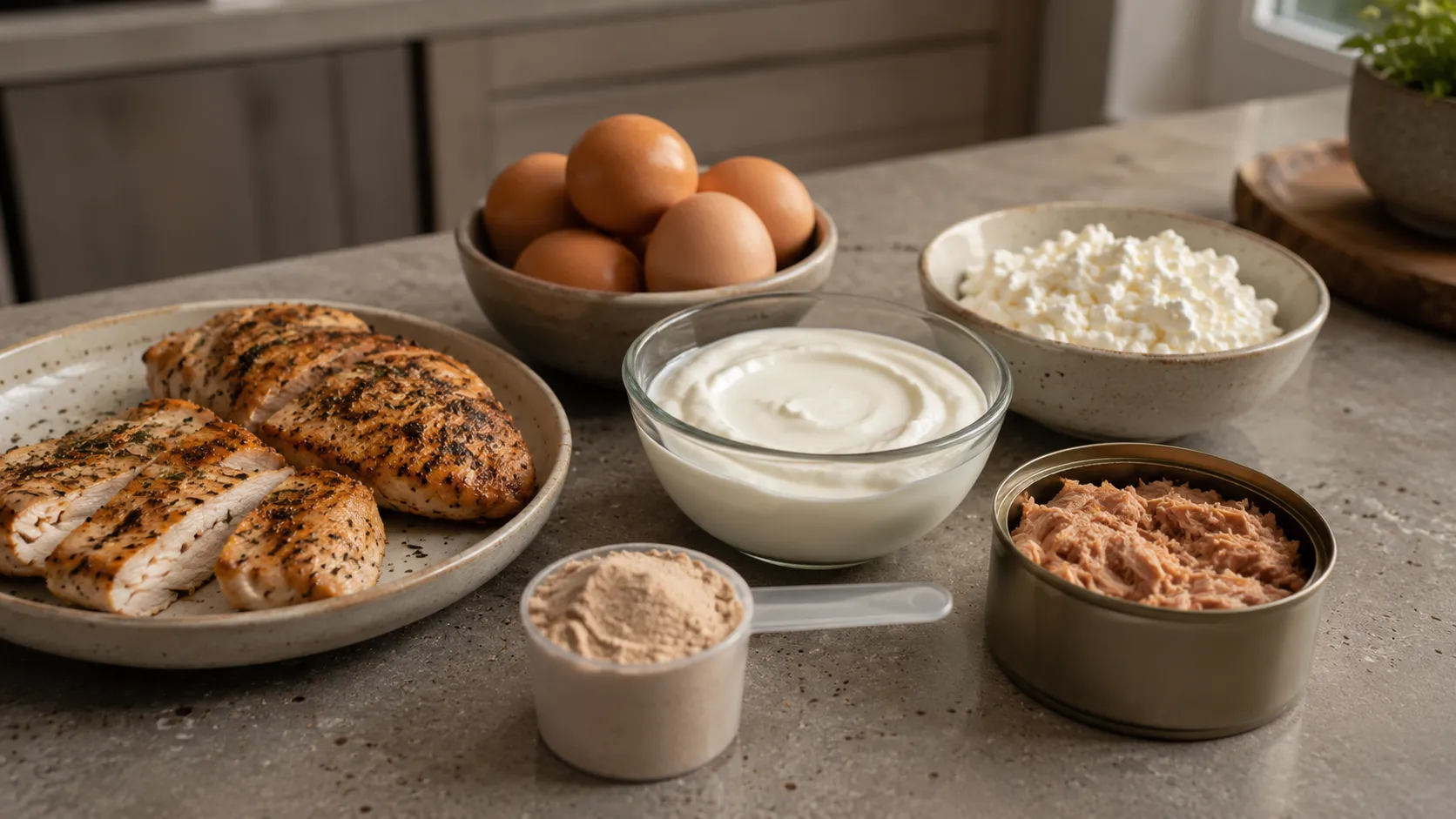
There’s one thing I see over and over with clients trying to lose fat on their own: almost everyone is under-eating protein. The recommendation you grew up with (0.8 grams per kilogram of bodyweight) is actually the bare minimum to prevent deficiency, not the amount you need to lose fat (at least not without losing precious muscle with it). The actual number is roughly twice that, and most people aren’t even coming close. This article gives you the exact target you should be hitting, the math you need to do to find your number, and the four easiest ways to hit it without forcing the calories.
Here’s the short version: to lose fat without losing muscle, you need to eat 1.6 to 2.2 grams of protein per kilogram of bodyweight per day. For a 70 kg (155 lb) adult, that is 112 to 154 grams daily, spread across three to four meals clocking in around 30 to 40 grams each. Don’t underestimate how important this is. Protein is the single most underrated lever in fat loss. It preserves muscle, blunts hunger, has the highest thermic effect of any macronutrient, and is the easiest piece of a fat loss plan to control.
Not sure if you are hitting your protein number?
Book a free 15-minute consult with our Winnipeg-based nutrition coaches. We'll calculate your exact target, audit your current intake, and confirm your insurance coverage on the call.

The Exact Number
The research on protein for body composition is actually one of the most consistent areas in sports nutrition. Across decades of studies, the range that consistently protects muscle and supports fat loss in adults is:
- 1.6 grams per kilogram of bodyweight per day at the low end (active adults, mild deficits)
- 2.2 grams per kilogram per day at the high end (older adults, larger deficits, more intense training, women breastfeeding or in perimenopause, etc.)
Examples:
- 130 lb (59 kg) woman: 94 to 130 grams of protein per day
- 155 lb (70 kg) adult: 112 to 154 grams per day
- 180 lb (82 kg) adult: 131 to 180 grams per day
- 220 lb (100 kg) adult: 160 to 220 grams per day
Two notes on these numbers:
If you are significantly overweight (BMI 30+), use your goal weight or your lean body mass for the calculation, not your current weight. The 1.6 to 2.2 g/kg target applies to lean mass, and using current weight at high BMI overshoots your actual needs.
If you’re over 50, lean toward the higher end of the range. Anabolic resistance (the muscle's reduced ability to respond to protein) increases with age, and slightly more protein helps overcome it.
"When clients tell me they’re stuck, the first thing I ask them is what their breakfast looks like. If it’s a coffee and a piece of toast, I don’t need to hear much else to conclude that they’re under-eating protein. It’s a foundational part of your fat loss, not optional." Anthony Guzzi, GFIT Fat Loss Transformation Coach
Why Protein Matters More Than the Other Macros
1. Protein protects muscle during fat loss
In a calorie deficit, your body has a choice about what to burn for fuel. With adequate protein and resistance training, it will burn mostly fat. With inadequate protein, a meaningful percentage of what you lose ends up being muscle, which lowers your metabolic rate, hurts your insulin sensitivity, and sets you up to regain faster. Hitting your protein intake in a deficit = the difference between actually becoming leaner and just a smaller, weaker version of you.
2. Protein is the most satiating macronutrient
Gram for gram, protein keeps you fuller longer than carbs or fats. Studies consistently show that higher-protein diets reduce daily caloric intake by 200 to 400 calories spontaneously, with no conscious restriction. This is why we tell every client at GFIT to start with protein intake before fixing anything else. The hunger management benefits alone usually solve half the problem.
3. Protein has the highest thermic effect
The thermic effect of food (TEF) is the energy your body burns to digest and metabolize what you eat. Protein has the highest TEF of any macronutrient at 20 to 30%. Carbs are 5 to 10%, while fats are 0 to 3%. That means roughly 25% of the calories you eat from protein are burned just through the process of digesting them. Over a day, a high-protein diet burns 80 to 150 more calories than a low-protein diet of the same total calories.
4. Protein is the easiest macro to track
Carbs and fats are hidden everywhere. Protein is concentrated in obvious foods. Building meals around protein anchors simplifies the entire tracking process: hit your protein, and the rest tends to fall into place.
How to Actually Hit Your Number (GFIT’s 4 Protein Structures)
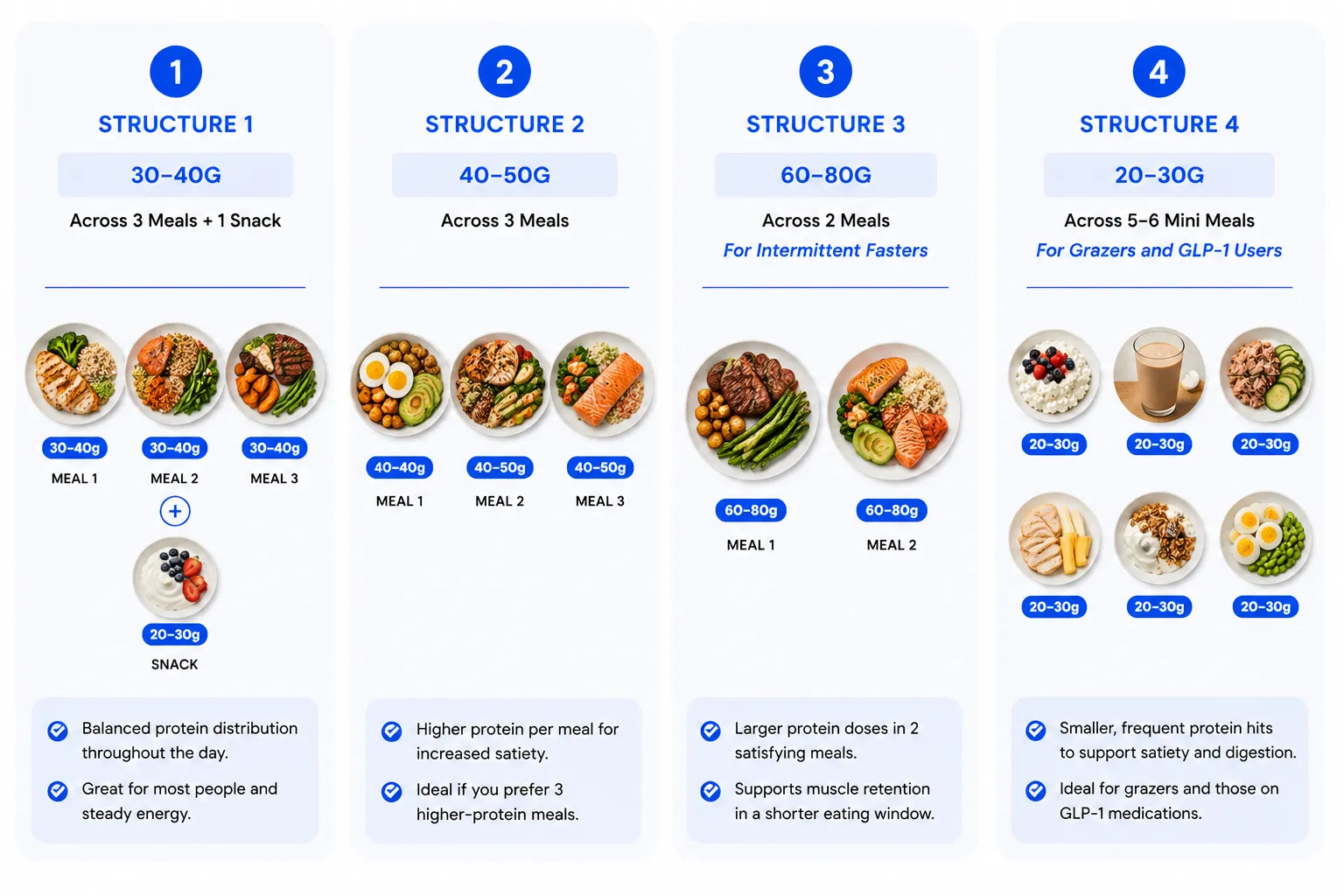
Knowing the target is easy; hitting it consistently is the work. We call this GFIT’s 4 Protein Structures. You pick the one that best fits your life:
Structure 1: 30 to 40 grams per meal, three meals plus one snack
Distributes protein evenly across the day for maximum muscle protein synthesis. Targets:
- Breakfast: 30 to 40 g (2 eggs + Greek yogurt + a scoop of protein powder).
- Lunch: 35 to 45 g (chicken breast + side, or tuna + greens + edamame).
- Snack: 20 to 25 g (Greek yogurt, cottage cheese, or a protein bar).
- Dinner: 30 to 40 g (lean protein anchor + sides).
Structure 2: 40 to 50 grams per meal, three meals (no snack)
Works for people who naturally skip snacks. Slightly larger meals, no afternoon eating window. Same total daily target.
Structure 3: 60 to 80 grams per meal, two meals (for intermittent fasters)
If you eat in an 8-hour window, you need bigger protein hits per meal. Two meals at 60 to 80 g each get you to the target. This is the hardest to execute because most people fill up before reaching the protein target at the back end of the meal - use with caution.
Structure 4: Protein-anchored grazing
Five to six smaller protein-containing meals, 20 to 30 g each. Works for people with unpredictable schedules, frequent travel, or appetite suppression (e.g., GLP-1 medications).
The 3 Ways Most People Get Protein Wrong
Mistake 1: Trying to reach your goal with low-protein foods
A slice of bread has 3 grams of protein. A handful of almonds has 6 grams. A cup of milk has 8 grams. A tablespoon of peanut butter clocks around 4. None of these are great protein sources. They are foods that contain trace protein. The protein we care about comes from foods where protein is the dominant macronutrient: meat, fish, eggs, dairy, legumes, and protein powder. This is what you want to build your meals around.
Mistake 2: Front-loading protein in the morning only
Eating 60 grams of protein at breakfast and 20 grams the rest of the day technically adds up to your target, but produces worse muscle preservation than spreading it evenly. Muscle protein synthesis is a per-meal event, not a daily total. Three meals at 30 to 40 grams beats one meal at 80 grams every time.
Mistake 3: Skipping breakfast protein
Roughly 70% of people we see eat their lowest-protein meal first thing in the morning, often just coffee or fruit. By lunch, they are too hungry to make good food decisions, and by dinner, they’re stuck trying to back-load a day's worth of protein into a single meal. It just doesn’t work. The fix is to anchor breakfast with 30 to 40 grams of protein, non-negotiable. A protein shake works if solid food is hard.
One of our Winnipeg clients, Mark, came to us logging "around 100 grams" of protein per day. When we asked him to weigh and track for three days, the actual number was 62 grams. He wasn’t lying. He was just estimating, and the estimate was off by 40%. We didn’t change his calories. We just hit 130 grams of tracked protein per day for the next eight weeks. He lost 9 pounds, gained measurable strength, and improved his body composition just from that one change.
The Best High-Protein Foods (Per Calorie)

- Chicken breast: 31 g protein per 100 g cooked, 165 cal. Highest protein-to-calorie ratio of any whole food.
- White fish (cod, tilapia, haddock): 20 to 25 g per 100 g, 80 to 110 cal.
- Tuna in water: 25 g per 100 g, 110 cal.
- Egg whites: 11 g per 100 g, 50 cal.
- Greek yogurt (0 or 2%): 10 g per 100 g, 60 to 80 cal.
- Cottage cheese (1%): 12 g per 100 g, 70 cal.
- Whey isolate powder: around 24 g per 30 g scoop, 110 cal.
- Lean ground turkey or chicken (93%+): 22 g per 100 g, 130 cal.
- Edamame (frozen, shelled): 11 g per 100 g, 120 cal.
- Tofu (extra firm): 15 g per 100 g, 110 cal.
When to Bring in a Coach
DIY protein math works once you understand the framework - but here are three signs you should bring in a coach:
- You’ve tracked for two weeks and consistently fall 20+ grams short of your target.
- Your appetite, schedule, or food preferences make the standard structures impractical.
- You’re on a GLP-1 medication and need a low-volume, high-protein meal structure that works with your suppressed appetite.
At GFIT, our nutrition coaching is built around exactly this. Most Winnipeg clients are insurance-covered through Manitoba Blue Cross, Canada Life, Sun Life, Manulife, or Green Shield.
Get your protein dialled in
Book a free 15-minute consult with our nutrition team. We'll calculate your target, audit your current intake, build a structure that fits your day, and confirm your insurance coverage on the call.
Frequently Asked Questions
1.6 to 2.2 grams of protein per kilogram of bodyweight per day. For a 70 kg (155 lb) adult, that is 112 to 154 grams daily, spread across three to four meals at 30 to 40 grams each. This range protects muscle, blunts hunger, and supports fat loss while in a calorie deficit.
No, not for people with healthy kidneys. The myth that high protein damages kidneys comes from studies on people with pre-existing kidney disease, where protein management matters. In healthy adults, intakes up to 3 g/kg per day have shown no adverse kidney effects in the literature. If you have kidney disease, the answer is different and you need a nephrologist's guidance.
There is a per-meal ceiling for muscle protein synthesis around 40 to 50 grams for younger adults and possibly higher for older adults (the anabolic ceiling research is still evolving). Protein above that ceiling still has value for satiety and amino acid pool, but the muscle-building return diminishes. The practical recommendation is 30 to 50 grams per meal, three to four meals a day.
Per gram, isolated whey protein powder at roughly 80% protein by weight. Among whole foods, chicken breast and lean white fish are the highest protein-to-calorie ratios. Per serving, a 100 g serving of cooked chicken breast at 31 g protein is hard to beat.
No, but it is the easiest way for most people, especially beginners. Hitting 130 to 150 grams of protein from whole food alone requires significant meal volume. One or two protein shakes per day shortcuts the math without adding much calorie volume. We recommend whey isolate or a clean plant blend for most clients.




Book a call with our Wellness Coordinator to learn more


