
Fat Loss Plateau: The 5 Reasons You're Stuck (And How to Break Through)

Six weeks ago, the scale was moving steadily and predictably. But today? Three weeks in a row, the number hasn’t budged. Your training, eating and stress levels are the same - and yet, somehow, your progress seems like it’s totally stopped. The good news is that almost every fat loss plateau falls into one of five categories, and four of them have a clear, fast fix. This article will help you figure out which one you might be experiencing and what we can do about it.
The five most common plateau causes are: hidden caloric intake increase, metabolic adaptation, scale fluctuations due to water and stress, ineffective training, and life rhythm disruptions. The 14-day diagnostic protocol at the end of this article walks you through ruling each one out and produces visible progress within two weeks for most people.
Stuck on a fat loss plateau for more than 14 days?
Book a free 15-minute consult with our Winnipeg fat loss plateau coaching team. We'll run the diagnostic on your specific situation, identify the most likely cause, and confirm your insurance coverage on the call.

First, What Actually Counts as a Plateau?
A real plateau is at least three consecutive weeks of no average weekly weight loss, while your inputs (calorie intake, training, sleep) have stayed consistent. Anything shorter than three weeks doesn’t count.
Daily weight can move 2 to 4 pounds in either direction based on water, sodium, hormones, digestion, and sleep, without any change in actual body fat. So if you’re panicking over those normal fluctuations, this article isn’t for you. You’re not in a true plateau. Switch to a weekly average (sum your daily weigh-ins, divide by seven, compare week to week) before concluding that you’re stuck.
The 5 Most Common Plateau Causes
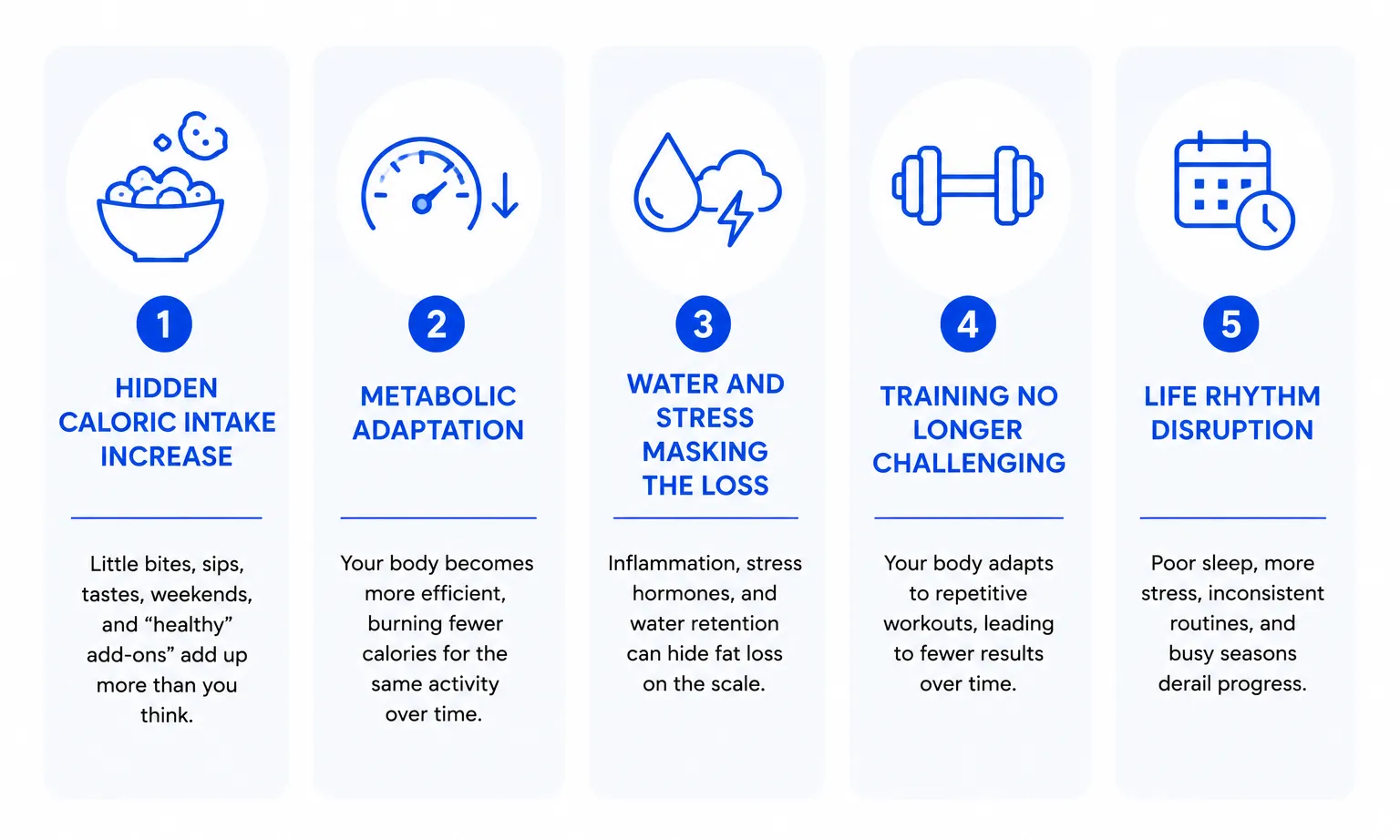
1. Hidden caloric intake increase
This is the most common cause of plateaus by a wide margin, and the hardest to spot from the inside. The plateau is rarely about the meals you log. It is about the calories you stopped logging.
Common culprits we see in client food diaries:
- Coffee additions (cream, oat milk, syrup) that add 50 to 200 calories per cup, untracked.
- Tasting while cooking. Two bites here or a spoonful there can easily add 200 to 400 calories per meal you prepare.
- Restaurant portions you eyeballed and undercounted. A typical "healthy" restaurant entrée is 30 to 50% more calories than its at-home equivalent.
- Weekend drift. Five days of tight tracking plus two days of "close enough" can erase the entire week's deficit.
- Liquid calories: alcohol, smoothies, juices, kombucha. They don’t feel like food or keep you full, but they count.
The fix: track every bite, sip, and lick honestly for three days. Most plateaued clients find 300 to 500 hidden daily calories they had no clue they were eating, and simply bringing awareness breaks the plateau.
2. Metabolic adaptation
If you’ve been in a calorie deficit for 3 to 6 months, your body has most likely adapted to the lower intake. Cortisol creeps up, thyroid output dips, NEAT (your non-exercise activity that includes fidgeting, walking, gesturing) quietly drops, and the deficit you started with is no longer a deficit.
This is biology, not a personal failure. And the fix is counterintuitive: eat more for one to two weeks, at maintenance calories, then return to your deficit. This is called a diet break, and it consistently restarts fat loss faster than continuing to push the original deficit.
3. Water and stress masking the loss
Sometimes the scale isn’t moving, but you are actually losing fat. Your clothes feel looser, your measurements are dropping, your strength is up, but the scale is stuck. And this is almost always water retention from one of four causes:
- New training stimulus: starting a new strength program causes 2 to 5 pounds of muscle water retention in the first three weeks.
- Higher cortisol: stress raises cortisol, which raises aldosterone, which raises water retention. Up to 5 pounds is normal during a stressful period.
- Higher sodium: a couple of restaurant meals or a salty weekend can hold 2 to 4 pounds of water for several days.
- Menstrual cycle: pre-menstrual water retention is real and predictable. Compare cycle-day to cycle-day, not week to week.
The fix: take waist, hip, and thigh measurements monthly. If those are dropping while the scale is stuck, you’re losing fat. It’s just not showing on the scale. Wait it out.
4. Training that is no longer challenging
Bodies adapt to training stimulus. The program that built muscle and burned calories in month two stops doing either by month six if you haven’t progressed it. The same weights, same reps, and same intensity = diminishing returns.
Three progressions that restart progress:
- Add weight: 2.5 to 5 pounds on compound lifts every two to four weeks
- Add reps: hit the top of your prescribed rep range, then add a rep or set.
- Add intensity techniques: tempo work, pauses, drop sets. Use sparingly.
"Nine out of ten plateaus I work through with clients come back to one of two things: hidden calories, or training that stopped being challenging. The remaining one in ten is the interesting one. That is where coaching really earns the fee." Lana Jankovic, Fat Loss Coach for Midlife Women
5. Life rhythm disruptions (sleep, alcohol, schedule)
Sleep, alcohol, and schedule are the three silent drivers of plateaus. Each one alone can stall progress, but combined? They can erase months of momentum.
- Sleep: even one week of poor sleep raises ghrelin, lowers leptin, raises cortisol, and reduces NEAT by hundreds of calories per day. You eat more and burn less, often without noticing.
- Alcohol: three to four drinks per week adds 800 to 1,200 calories, disrupts sleep architecture for two to three nights, and suppresses muscle protein synthesis for 24 to 36 hours per drinking session.
- Schedule: high-travel weeks, intense work projects, family stress, and seasonal changes all compress the time you have for training and meal planning, which silently raises stress and can shift intake up.
The fix: audit the last 14 days against the previous 30. Did sleep average drop? Did alcohol intake increase? Did your training adherence slip? If yes to any, we’ve found the reason why the scale is stuck.
The GFIT 14-Day Plateau Reset
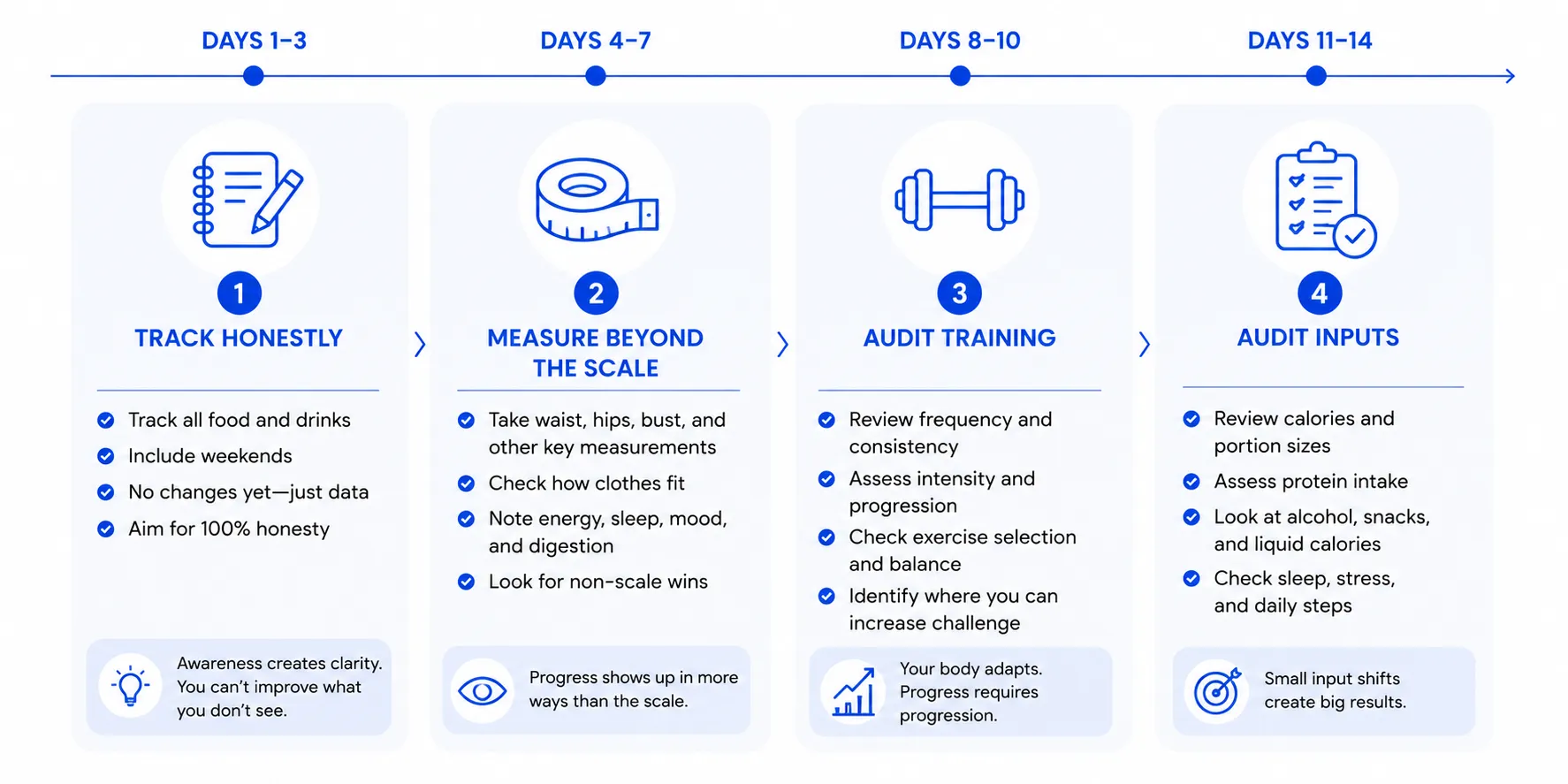
Before concluding the plateau is permanent, run the GFIT 14-Day Plateau Reset. We use it with every plateaued client.
Days 1 to 3: Track honestly
Every bite, sip, lick, and taste. No editing. No, "I do not need to track this." Three days is enough to spot the pattern. Most plateaued clients find 300 to 500 hidden daily calories in this step.
Days 4 to 7: Measure beyond the scale
Waist (at the navel), hips (widest point), thigh (mid-point), upper arm. Take a front, side, and back photo in the same lighting and clothing weekly. If the scale is stuck but your measurements or photos are showing progress, this isn’t a true plateau - fat loss is happening, the scale just isn’t reflecting it yet.
Days 8 to 10: Audit your training
Have you progressed your weights, reps, or intensity in the last six weeks? If not, start there.
Days 11 to 14: Audit your inputs (sleep, alcohol, stress)
Pick the one of the three that has clearly slipped the most in the last 30 days and fix it.
If after 14 days the plateau is still there, you’ve ruled out the four causes with easy fixes. The remaining one is metabolic adaptation, and the right move is a structured one to two-week diet break at maintenance calories before returning to your original deficit. That conversation is worth having with a coach, because it’s harder to calculate the correct numbers on your own.
One of our Winnipeg clients, Dave, hit a six-week plateau after losing 22 pounds. His tracking looked tight, and his training hadn’t changed. Like we do with all clients who hit a plateau, we ran the 14-day protocol. Days 1 to 3 of honest tracking revealed an extra 450 calories per day in untracked nut butter, restaurant portions, and weekend wine. We didn’t have to adjust anything dramatic to see progress again - he simply tracked accurately. Progress restarted, and the scale dropped 4 pounds in the following three weeks.
When to Bring in a Coach
DIY through a plateau works if you can be honest with the data and disciplined with the protocol. Three signs you should bring in help:
- You have run the 14-day protocol honestly and the plateau persists.
- You have plateaued more than once in the same year and the pattern is starting to feel familiar.
- You are afraid to add calories during a diet break, because every previous attempt at "eating more" turned into a regain.
At GFIT, our fat loss plateau coaching is built around exactly this diagnostic process. Most Winnipeg clients are insurance-covered through Manitoba Blue Cross, Canada Life, Sun Life, Manulife, or Green Shield, which usually means little to no out-of-pocket cost.
Stuck for more than 14 days? Get the diagnostic done with you.
Book a free 15-minute consult with our Winnipeg fat loss plateau team. We'll work the 14-day protocol with you, surface the cause, and confirm your insurance coverage on the call.
Frequently Asked Questions
Three consecutive weeks of no average weekly weight loss while your inputs have stayed consistent. Anything shorter is normal weight fluctuation. Anything longer than four weeks of true plateau is worth running the 14-day diagnostic on.
Almost never. Eating less when you are already in a deficit accelerates metabolic adaptation, raises cortisol, increases hunger, and makes the next phase harder. The right move is almost always to find the hidden calories that are silently sabotaging the existing deficit, or to take a structured diet break at maintenance and then return.
Usually not. More cardio without progressive strength training accelerates muscle loss, raises hunger, and creates the same kind of metabolic adaptation that the eating side does. If your cardio has been the same for months, change the modality or intensity instead of adding volume.
A diet break is a planned 7 to 14 day return to maintenance calories during a longer fat loss phase. The goal is to reduce metabolic adaptation, restore satiety hormones, and reset adherence. After the break, you return to your previous deficit. Done properly, a diet break almost always restarts fat loss faster than continuing to push the original deficit.
Starting a new strength program causes 2 to 5 pounds of water retention in the muscles for the first 2 to 3 weeks. This is normal, healthy, and a sign that your training is working. The scale catches back up once the water retention settles. Look at body measurements and photos during this window to assess progress - not the scale.





Book a call with our Wellness Coordinator to learn more


