
Online Fitness Coaching vs Personal Training in Winnipeg
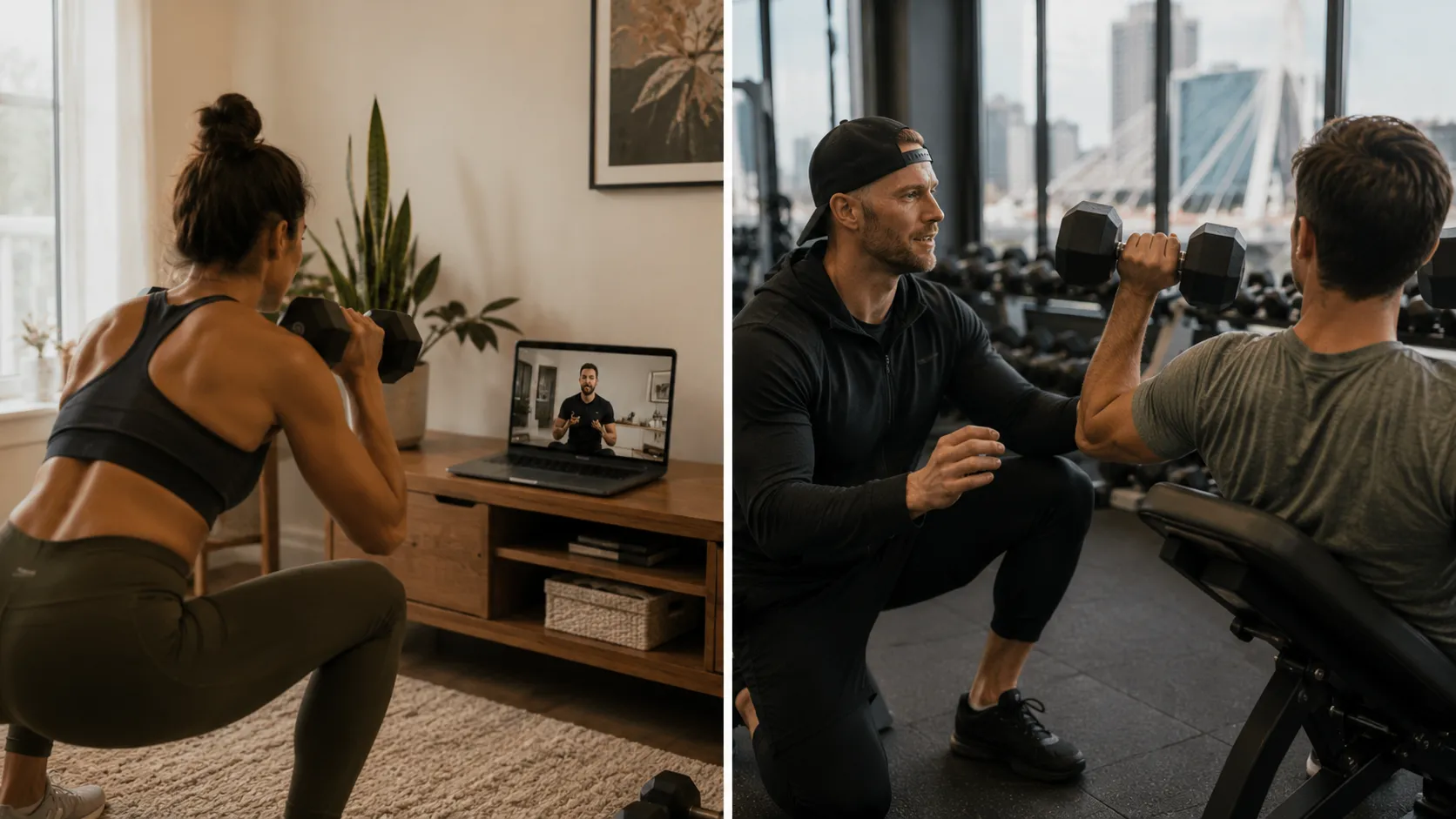
So you’ve decided you need help reaching your fitness goals. That’s great! The question now becomes: which kind? In person, or online?
An in-person personal trainer at a Winnipeg gym costs $80 to $120 per session, with no nutrition coaching or accountability between sessions. Online fitness coaching costs $200 to $400 per month total (less if you can use your insurance benefits), is done completely virtually, includes nutrition guidance, and can be tailored to your lifestyle. There are pros and cons to both options, and the honest answer to which is better is: it depends on you. This article is the side-by-side comparison that most articles on this topic won’t give you, including which format we recommend at GFIT.
To put it shortly, online fitness coaching wins for people who want a complete program (training plus nutrition plus accountability), travel often or have unpredictable schedules, or are working through a specific body composition goal over months. In-person personal training wins for people new to lifting who need hands-on form correction, people working through injury rehabilitation, and people who are accountability-driven by having a scheduled time slot. Both can work, but picking the wrong format is the most common reason coaching fails.
Not sure which format fits your situation?
Book a free 15-minute consult with our Winnipeg team. We'll honestly recommend in-person or online based on your goals, schedule, and budget. No pressure, no upsell, no commitment.

The Honest Pros and Cons
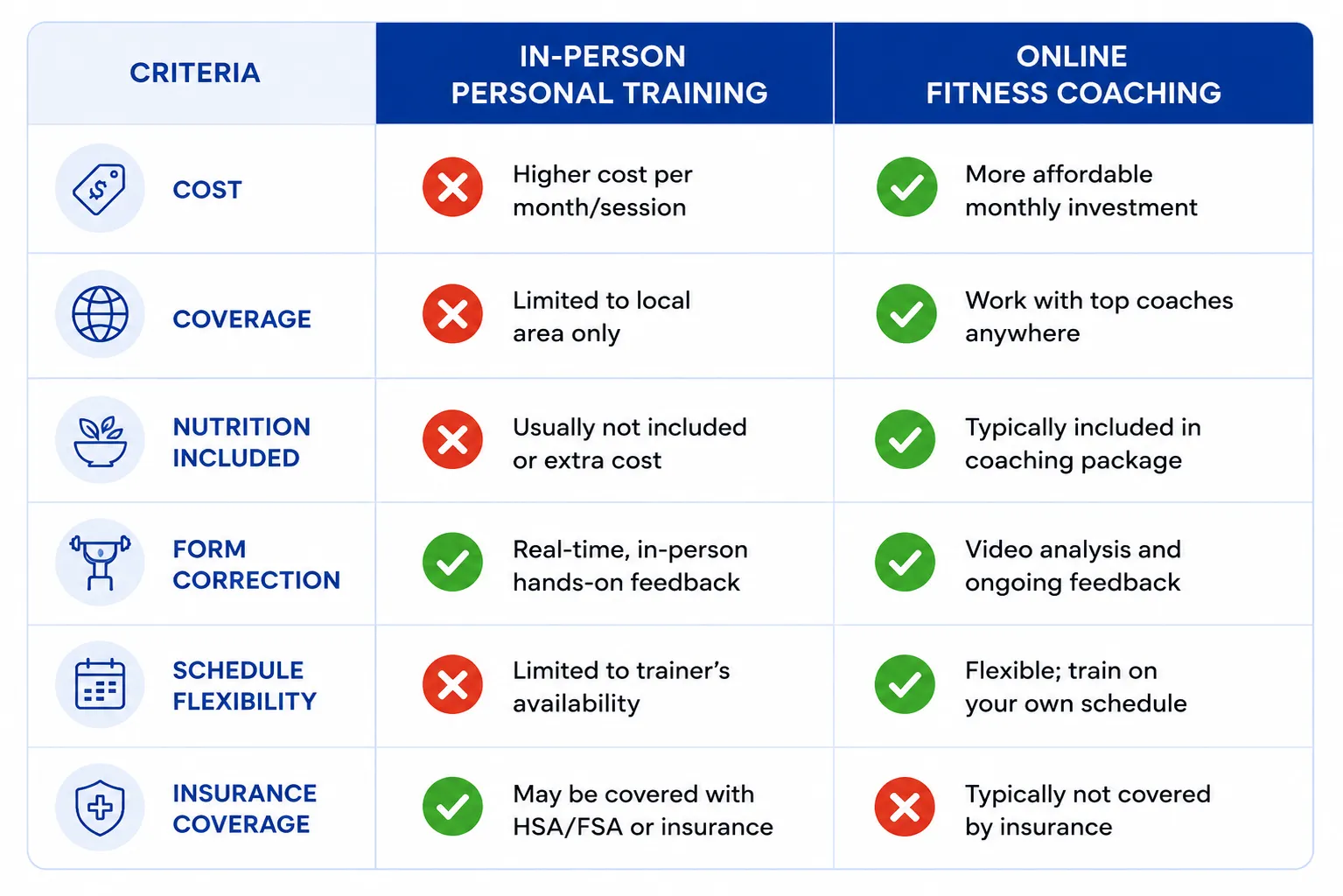
Comparison table: in-person personal training versus online fitness coaching across cost, coverage hours, nutrition integration, form correction, schedule flexibility, and insurance coverage.
In-person personal training, the pros
- Provides hands-on form correction in real time (especially valuable in the first 6 to 12 weeks of strength training)
- Having a scheduled time slot creates external accountability. Many people show up simply because you’ve paid for the appointment, and the trainer is waiting.
- Equipment access. The gym has everything; you don’t need to buy or build a setup.
- The energy of the gym environment. Some people train harder around others.
In-person personal training, the cons
- Cost is high. $240 to $360 per week for 3 sessions, equating to about $12,000 to $19,000 per year.
- You only get coaching during sessions. The other 165 hours of the week, you’re on your own.
- Nutrition is usually out of scope. Most personal trainers in Winnipeg are not credentialed nutritionists, and most insurance does not cover trainer sessions.
- Travel disrupts everything. Vacation or work trip = missed sessions.
- Scheduling friction. Think cancellations, rescheduling, gym hours, and the drive.
Online fitness coaching, the pros
- Lower total cost. $200 to $400 per month is typical, often less than 4 in-person sessions (and the price will be even lower if you have insurance coverage)
- 24/7 coverage. Your program and your coach are in your pocket every day.
- Integrated nutrition. Most online coaches build training and nutrition into one program.
- It travels with you. The program runs the same in Winnipeg as in a hotel gym in Toronto.
- Often insurance-covered. Many extended health plans cover the nutrition portion of an online coaching program.
- Coaching ‘on the fly’. You can message your coach when something comes up and get a response within hours. You don’t need to wait for a session.
Online fitness coaching, the cons
- No hands-on form correction. You can video your lifts and have your coach review, but it’s not the same as in-person.
- Requires self-direction. You do the workout on your own time, which works for most people but not all.
- Equipment setup depends on you. Some programs assume gym access; others work with bodyweight or home setups.
- Less social. No gym community by default.
“Clients can succeed both online and in person, but there are definitely some people who thrive in one environment over the other. It’s about knowing yourself and being honest about what you actually need to succeed.” - Makayla Debellis, Skinny to Strong Muscle Gain Coach at GFIT
Side-by-Side: The Numbers
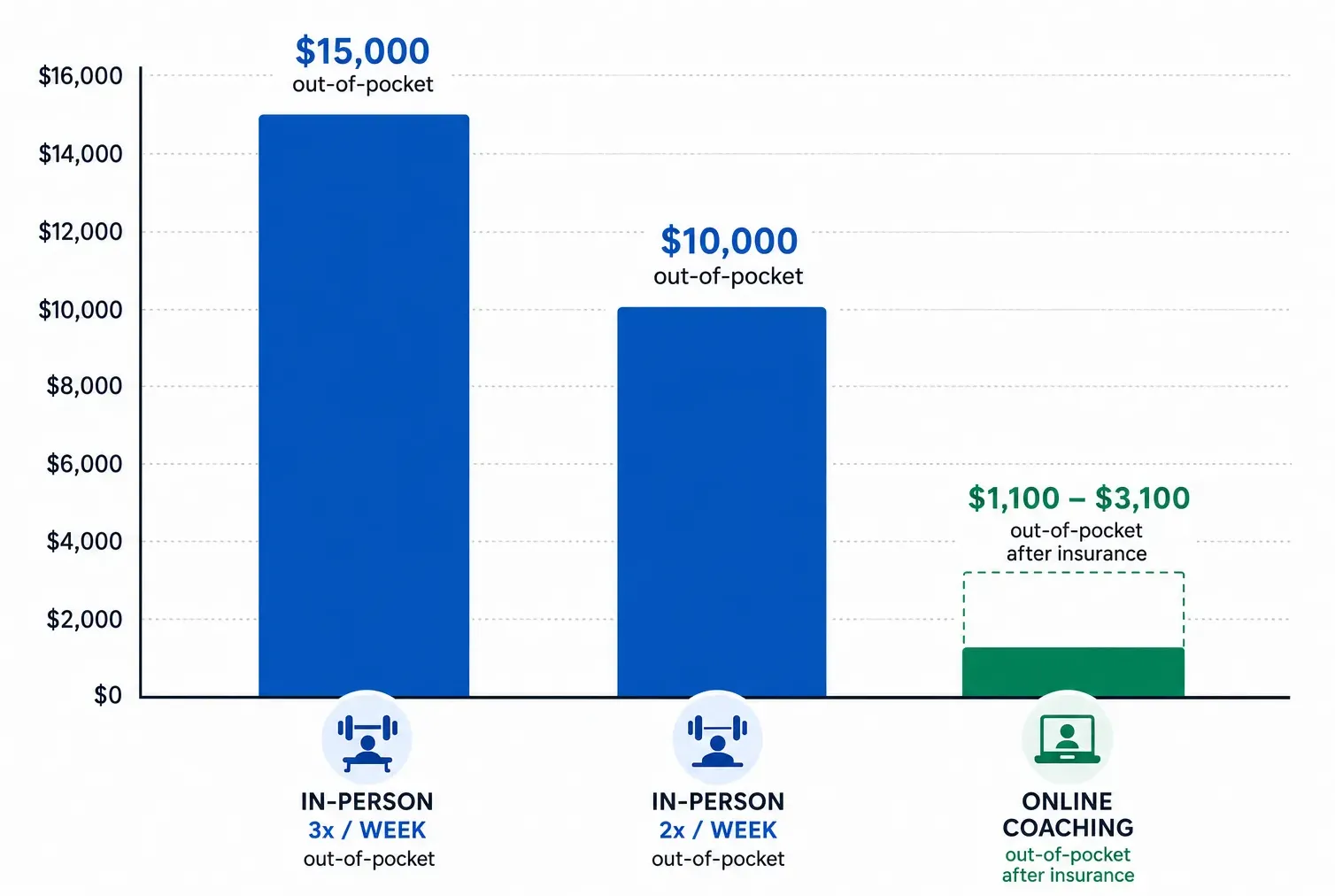
Annual cost comparison for a typical client profile:
In-person personal training, 3 sessions/week, 50 weeks/year
- Cost: 150 sessions x $100 average = $15,000.
- Insurance coverage: usually $0 (personal training is rarely covered).
- Out-of-pocket annual: $15,000.
In-person personal training, 2 sessions/week, 50 weeks/year
- Cost: 100 sessions x $100 average = $10,000.
- Out-of-pocket annual: $10,000.
Online fitness coaching, monthly recurring
- Cost: $300/month x 12 = $3,600.
- Insurance coverage if combined with nutrition coaching: $500 to $2,500 per year typical, depending on plan.
- Out-of-pocket annual: $1,100 to $3,100.
Who Each Format Actually Works Best For
Choose in-person personal training if:
- You’re brand new to strength training and need form correction on your lifts.
- You’re recovering from an injury and need specific rehab.
- You’ll only do the workout if someone is watching the clock.
- You don’t have major body composition goals.
- Cost is not the primary constraint.
Choose online fitness coaching if:
- You want nutrition and training combined in one program.
- You’re familiar with basic exercises and can execute a workout on your own.
- You travel for work, are a busy parent or have an unpredictable schedule.
- You have benefits coverage.
- You’re working toward a specific body composition goal.
What GFIT Actually Does
GFIT is an online coaching service: our services are entirely virtual, and often covered by insurance. Some of our coaches also provide in-person training at an additional cost, for clients who are local and need a hybrid approach.
Most of our online coaching clients in Manitoba are insurance-covered through Manitoba Blue Cross, Canada Life, Sun Life, Manulife, or Green Shield. Our team handles the paperwork and confirms your coverage.
One of our Winnipeg clients, Aaron, came to us after 14 months with an in-person personal trainer. He had gained strength, but still hadn’t lost the fat he was looking to lose. We moved him to online coaching with a tailored nutrition plan, fully covered by his insurance. Six months later, he was 18 pounds lighter, stronger on his main lifts, and the total program had cost him nothing out of pocket.
Want to find out which format fits you?
Book a free 15-minute consult with our Winnipeg team. We'll talk through your goals, schedule, and budget, and honestly recommend the right format. We'll also confirm your insurance coverage on the call.
Frequently Asked Questions
Yes! Our coaches build programs for whatever equipment you have, whether it’s a full home gym or a few dumbbells and a band. The training is adapted to your setup, not the other way around. Most home programs work with just dumbbells, a pull-up bar, and a band.
It depends on the program. Pure fitness coaching is rarely covered. Coaching programs that include nutrition counselling from a registered dietitian are often covered under extended health plans (Manitoba Blue Cross, Canada Life, Sun Life, Manulife, Green Shield). GFIT structures its programs so the nutrition portion qualifies for coverage on most extended health plans.
Typical pricing is $200 to $400 per month for a complete program including training, nutrition, and coach support. GFIT online coaching starts at $295 per month, and most clients pay little to nothing out of pocket after extended health insurance coverage.
For most people, yes; and for many, it’s actually more effective. The outcome data on online coaching is comparable to or better than in-person training for fat loss, body composition, and habit formation. In-person wins for the beginner who needs hands-on form correction; online wins for almost everyone else.
A personal trainer is typically session-based and focused mostly on supervising your workouts. An online fitness coach is typically program-based, building and adjusting your training and nutrition plan over weeks or months. Both can work, but they solve different problems. If you need someone to supervise your workout, you need a trainer. If you need someone to build your 12-week program, check in on your execution and help you hit your body composition goals, you need a coach.





Book a call with our Wellness Coordinator to learn more


